Simulasi Pola Arus Laut di Pelabuhan Gilimanuk Menggunakan Metode Computational Fluid Dynamics
DOI:
https://doi.org/10.26418/pf.v12i3.85295Keywords:
Arus, Pelabuhan Gilimanuk, Delft3DAbstract
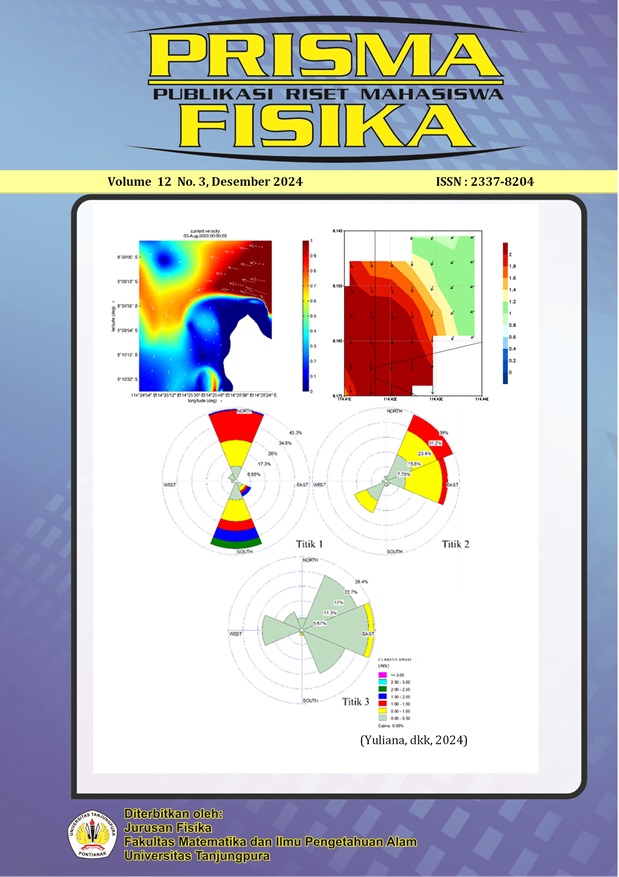
Pelabuhan Gilimanuk merupakan pelabuhan penyebrangan yang menjadi pusat transportasi vital sebagai pintu gerbang transportasi laut menuju Bali. Pelabuhan ini memiliki peran strategis dalam mendukung kegiatan perekonomian regional. Letaknya di Selat Bali menyebabkan kondisi navigasi perairannya dipengaruhi oleh pola arus yang kuat sehingga berpotensi mengganggu aktivitas operasional pelabuhan terutama dalam kondisi perairan yang buruk. Penelitian ini bertujuan untuk memodelkan dan menganalisis pola arus di kawasan Pelabuhan Gilimanuk guna meningkatkan keselamatan navigasi menggunakan metode numerik Computational Fluid Dynamics (CFD) dengan perangkat lunak Delft3D. Data yang digunakan dalam penelitian ini meliputi data batimetri dari GEBCO, komponen angin dan tekanan dari FNL, serta komponen pasang surut dari TPXO 08. Simulasi dilakukan selama tujuh hari pada bulan Agustus 2020, periode ini dipilih karena merupakan bulan dengan kondisi arus terkuat sepanjang tahun menurut studi sebelumnya. Hasil simulasi menunjukkan bahwa kecepatan rata-rata arus di kawasan pelabuhan berkisar antara 0,2 hingga 0,6 m/s, dengan kecepatan maksimum mencapai 2 m/s di bagian utara pelabuhan, di mana arus masuk melalui mulut Selat Bali dari Laut Bali. Arus dengan kecepatan tinggi ini bergerak dari berbagai arah, termasuk utara, barat, barat daya, dan selatan, menunjukkan bahwa seluruh area pelabuhan rentan terhadap arus kuat.
Downloads
Published
Issue
Section
License
Copyright Notice using Creative Commons License for an Online Journal
The online journal Prisma Fisika operates under a Creative Commons Attribution-NonCommercial-ShareAlike 4.0 International License (CC BY-NC-SA 4.0). This copyright notice serves to inform authors, readers, and users of the terms and conditions regarding the use and distribution of the journal's content. By submitting or accessing the content, you agree to the following:
1. Content License:
a. All articles, images, and supplementary materials published in Prisma Fisika are licensed under the Creative Commons Attribution-NonCommercial-ShareAlike 4.0 International License.
b. This license permits users to copy, distribute, and adapt the content for non-commercial purposes, provided appropriate credit is given to the original authors and the journal.
c. If you remix, transform, or build upon the content, you must distribute your contributions under the same license as the original.
2. Attribution:
a. When using or sharing content from Prisma Fisika, you must properly attribute the original authors and the journal.
b. Include the title of the article, the names of all authors, Prisma Fisika, the year of publication, the volume/issue number, and the specific page numbers.
c. Provide a hyperlink to the original article on Prisma Fisika's website, if applicable.
3. Non-Commercial Use:
a. The content published in Prisma Fisika may not be used for commercial purposes without obtaining explicit permission from the copyright holders.
b. Commercial use includes, but is not limited to, reproduction or distribution of the content for financial gain, selling or licensing the content, or using the content in products or services that are sold or monetized.
4. ShareAlike:
a. If you adapt or remix the content from Prisma Fisika, you must distribute your derivative work under the same Creative Commons Attribution-NonCommercial-ShareAlike 4.0 International License.
b. This provision ensures that any modifications, adaptations, or remixes of the content maintain the same open licensing framework.
5. Disclaimer:
a. The views expressed in articles published in Prisma Fisika are solely those of the authors and do not necessarily reflect the opinions or policies of the journal, its editorial board, or affiliated institutions.
b. Prisma Fisika and its editors are not liable for any errors, omissions, or damages arising from the use or interpretation of the published content.
Please note that this Copyright Notice does not supersede any additional permissions or restrictions that may be granted by individual authors or copyright holders for their specific content within Prisma Fisika. For any questions or requests regarding the use of the journal's content, please contact the editorial team at prismafisika@physics.untan.ac.id.
By accessing or contributing to Prisma Fisika, you agree to comply with the terms of this Creative Commons license. Violation of these terms may result in legal consequences as governed by applicable copyright laws.
Date: 24-05-2023
Prisma Fisika
Email: prismafisika@physics.untan.ac.id
