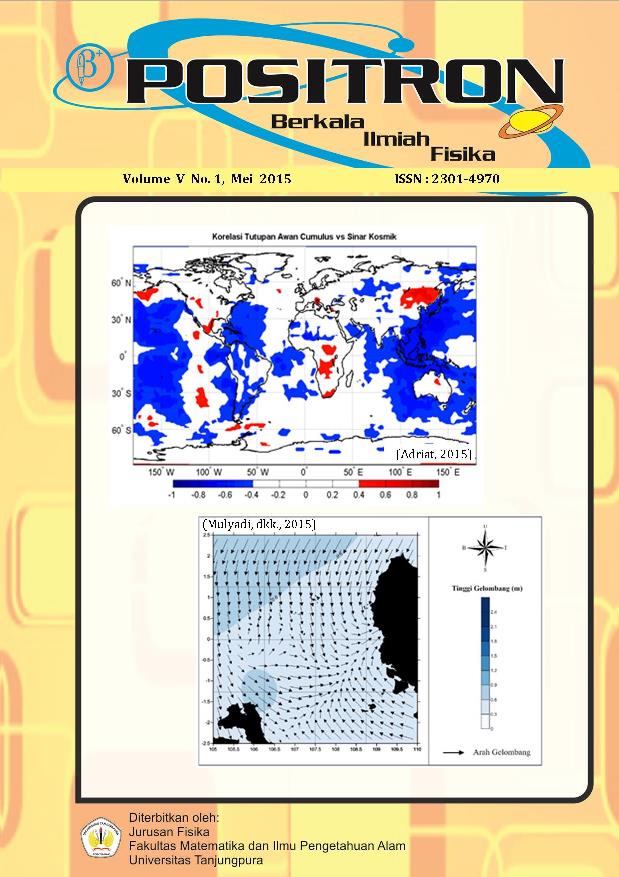
Prediksi Ketinggian Gelombang Laut Perairan Laut Jawa Bagian Barat Sebelah Utara Jakarta dengan Metode Jaringan Syaraf Tiruan Propagasi Balik
DOI:
https://doi.org/10.26418/positron.v5i1.9749Abstract
Telah dilakukan estimasi dan prediksi ketinggian gelombang perairan Laut Jawa bagian Barat sebelah Utara Jakarta menggunakan metode Jaringan Syaraf Tiruan Propagasi Balik. Data yang digunakan yaitu data ketinggian gelombang laut maksimum mingguan, dari tahun 2005 sampai dengan 2014. Jaringan Syaraf Tiruan (JST) yang digunakan adalah JST Propagasi Balik berarsitektur [40 30 20 1] dengan distribusi lapisan yang terdiri dari 6 lapisan input, 4 lapisan tersembunyi, dan 1 lapisan output. Fungsi aktifasi yang digunakan adalah fungsi linear, sigmoid bipolar dan sigmoid biner. Dari hasil pengujian diperoleh nilai koefisien korelasi pengujian di lima titik penelitian masing-masing 0,78; 0,70; 0,72; 0,74 dan 0,70. Hasil prediksi puncak gelombang maksimum terjadi pada minggu pertama November 2014, minggu pertama hingga keempat Desember 2014, minggu pertama Januari 2015, minggu keempat Maret 2015 dan minggu keempat April 2015.
Kata Kunci : Gelombang, Laut Jawa, JST, Propagasi Balik
Downloads
Published
Issue
Section
License
Authors who publish with this journal agree to the following terms:
- Authors retain copyright and grant the journal right of first publication with the work simultaneously licensed under a Creative Commons Attribution License that allows others to share the work with an acknowledgement of the work's authorship and initial publication in this journal.
- Authors are able to enter into separate, additional contractual arrangements for the non-exclusive distribution of the journal's published version of the work (e.g., post it to an institutional repository or publish it in a book), with an acknowledgement of its initial publication in this journal.
- Authors are permitted and encouraged to post their work online (e.g., in institutional repositories or on their website) prior to and during the submission process, as it can lead to productive exchanges, as well as earlier and greater citation of published work (See The Effect of Open Access).

This work is licensed under a Creative Commons Attribution 4.0 International License.
