
Jamur yang diisolasi dari Daun dan Batang Bergejala Sakit pada Tanaman Karet (HeveabrasiliensisMuell.Arg.) di Kabupaten Sanggau
DOI:
https://doi.org/10.26418/protobiont.v4i3.13314Keywords:
Hevea brasiliensis, Fungus, Organ with disease symptomsAbstract
The rubber tree(Hevea brasiliensis Muell.Arg.) at a certain age can be attacked by diseases caused by fungi. The symptoms of the disease may be form blackish brown spots on the stems, blackish white patches on the petiole, the tip of the leaf wrinkled, etc. This research aimed to find out the types of fungi isolated from the leaves and stems with symptoms of disease on the rubber tree at different age levels. The samples were taken using a cruise method based on the age level i.e. 0-9 months old, 2-5 years old, and > 5 years old. The research findings indicated that there were seven types of fungi found i.e. Fusarium V1, Colletotrichum V2, Phytophthora V3, Aspergillus V4, Penicillium V5, Mucor V6 and Chrysonilia V7. The leaves aged 0-9 months old the fungi found were Colletotrichum V2, Phytophthora V3, and Penicillium V5; on the leaves aged 2-5 years old i.e. Phytophthora V3 and Aspergillus V4; and at age > 5 years old, Fusarium V1, Phytophthora V3, Mucor V6 and Chrysonilia V7 were found on the stem organ.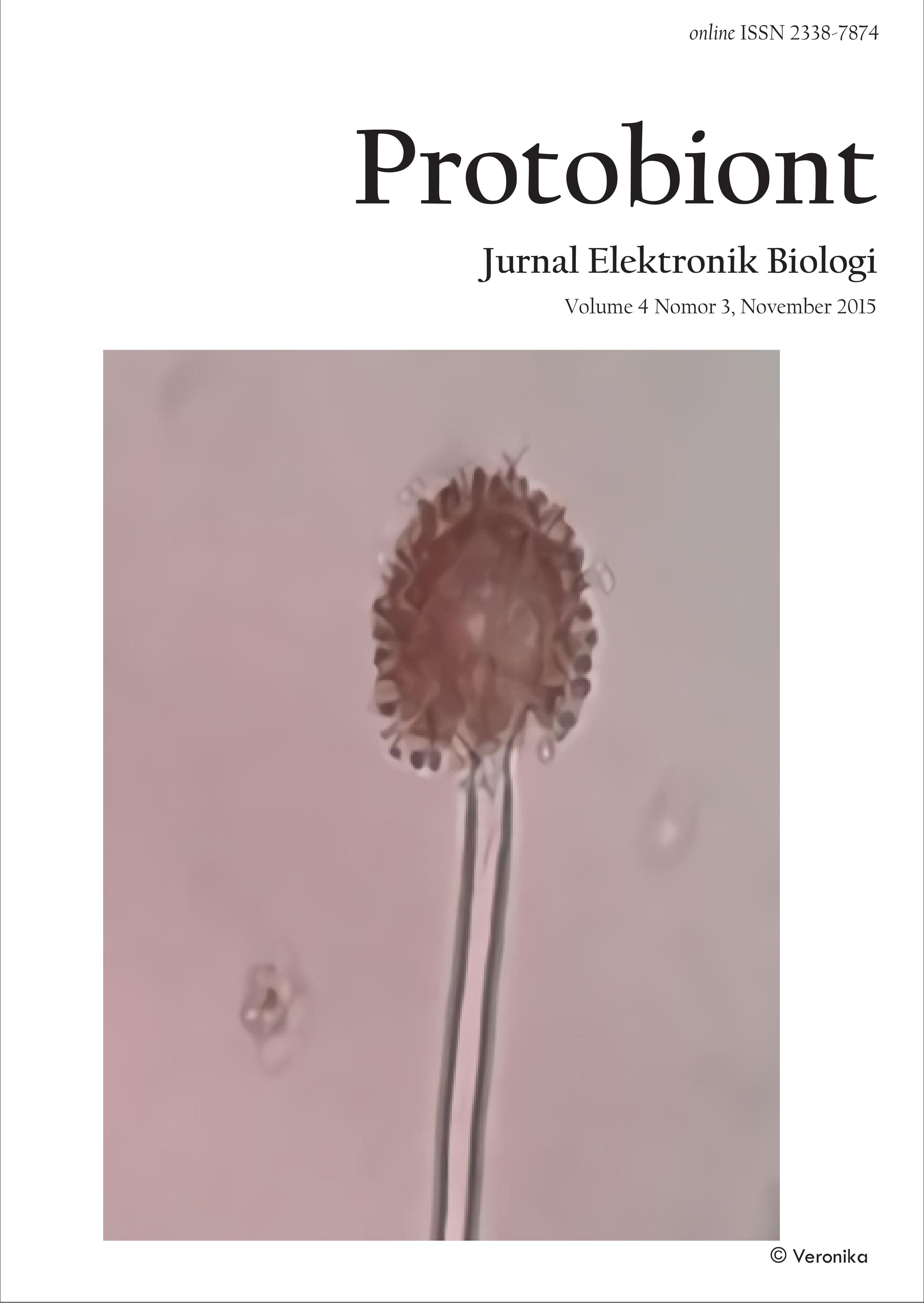
Downloads
Published
2016-01-14
Issue
Section
Articles
License
Authors who publish with this journal agree to the following terms:
- Authors retain copyright and grant the journal right of first publication with the work simultaneously licensed under a Creative Commons Attribution-ShareAlike License that allows others to share the work with an acknowledgement of the work's authorship and initial publication in this journal.
- Authors are not restricted by the journal from entering into separate, additional contractual arrangements for the non-exclusive distribution of the journal's published version of the work (e.g., posting it to an institutional repository or publishing it in a book), with an acknowledgement of its initial publication in this journal.
- Authors are permitted and encouraged to post their work online (e.g., in institutional repositories or on their website) after its publication in this journal. This approach aims to safeguard against potential plagiarism or unauthorized use of unpublished manuscripts, as outlined in the submission guidelines which state that this journal does not accept previously published manuscripts.
