
Inventarisasi Jenis Paku-Pakuan (Pteridophyta) di Hutan Sebelah Darat Kecamatan Sungai Ambawang Kalimantan Barat
DOI:
https://doi.org/10.26418/protobiont.v5i1.14883Keywords:
Identification, inventory, fern, forest.Abstract
Ferns (Pteridophyta) as a plant community in biodiversity has important ecological function in forest ecosystems and human living. The human activities on the forest may lead to ecosystems disruption and reducing natural resources preservation, including reducing ferns species in the forest. Inventory of ferns species need to be performed to gathering information for the preservation and development of the region. The research was conducted from Juni 2015 to September 2015. Ferns sampling was performed on Sebelah Darat, Lingga Village Forest, Sungai Ambawang District. Cruise method was employed to collect ferns. The results were obtained showing that there are 20 kinds of epiphytic and terrestrial ferns dividing of 11 families, Aspleniaceae, Blechnaceae, Davalliaceae, Dennstaedtiaceae, Lindsaeaceae, Lycopodiaceae, Lygodiaceae, Polypodiceae, Gleicheniaceae, Pteridaceae and Selaginellaceae.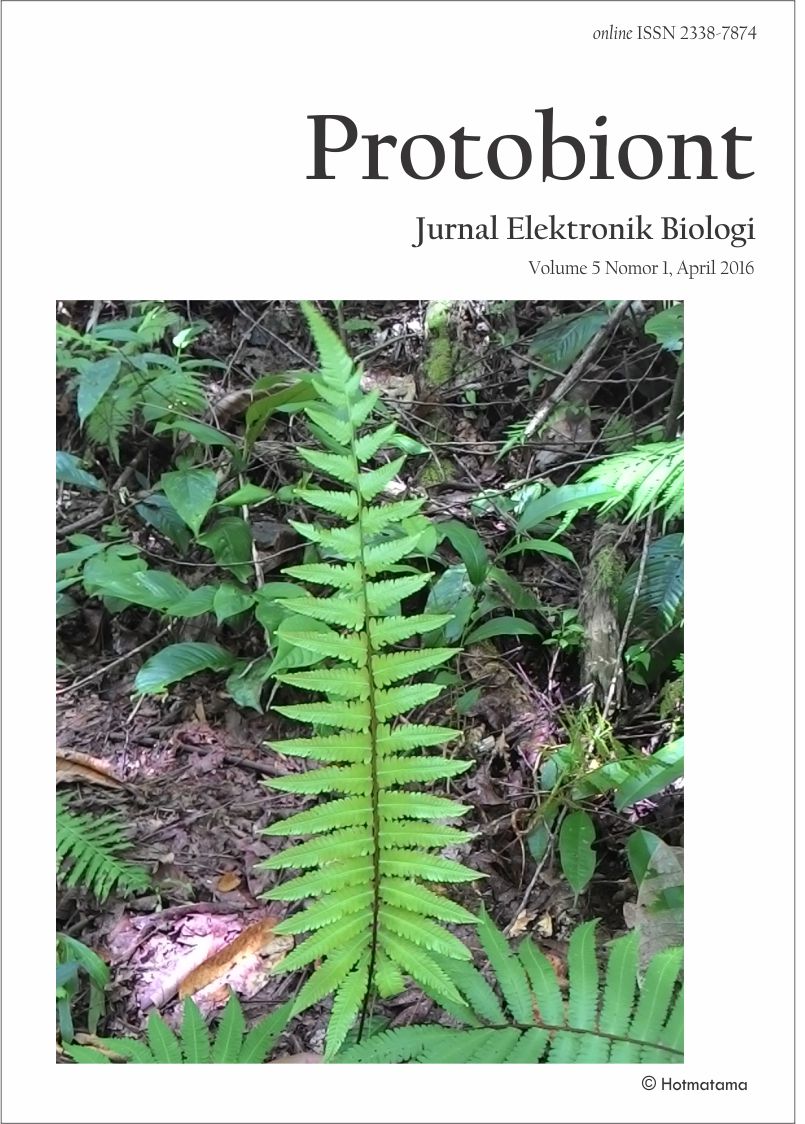
Downloads
Published
2016-04-15
Issue
Section
Articles
License
Authors who publish with this journal agree to the following terms:
- Authors retain copyright and grant the journal right of first publication with the work simultaneously licensed under a Creative Commons Attribution-ShareAlike License that allows others to share the work with an acknowledgement of the work's authorship and initial publication in this journal.
- Authors are not restricted by the journal from entering into separate, additional contractual arrangements for the non-exclusive distribution of the journal's published version of the work (e.g., posting it to an institutional repository or publishing it in a book), with an acknowledgement of its initial publication in this journal.
- Authors are permitted and encouraged to post their work online (e.g., in institutional repositories or on their website) after its publication in this journal. This approach aims to safeguard against potential plagiarism or unauthorized use of unpublished manuscripts, as outlined in the submission guidelines which state that this journal does not accept previously published manuscripts.
