
Struktur Anatomi Organ Vegetatif Kacang Panjang (Vigna sinensis (L.),var. BCA 02) pada Tingkat Salinitas yang Berbeda
DOI:
https://doi.org/10.26418/protobiont.v5i2.15923Keywords:
Vigna sinensis (L.), var. BCA 02, salinity, anatomical structureAbstract
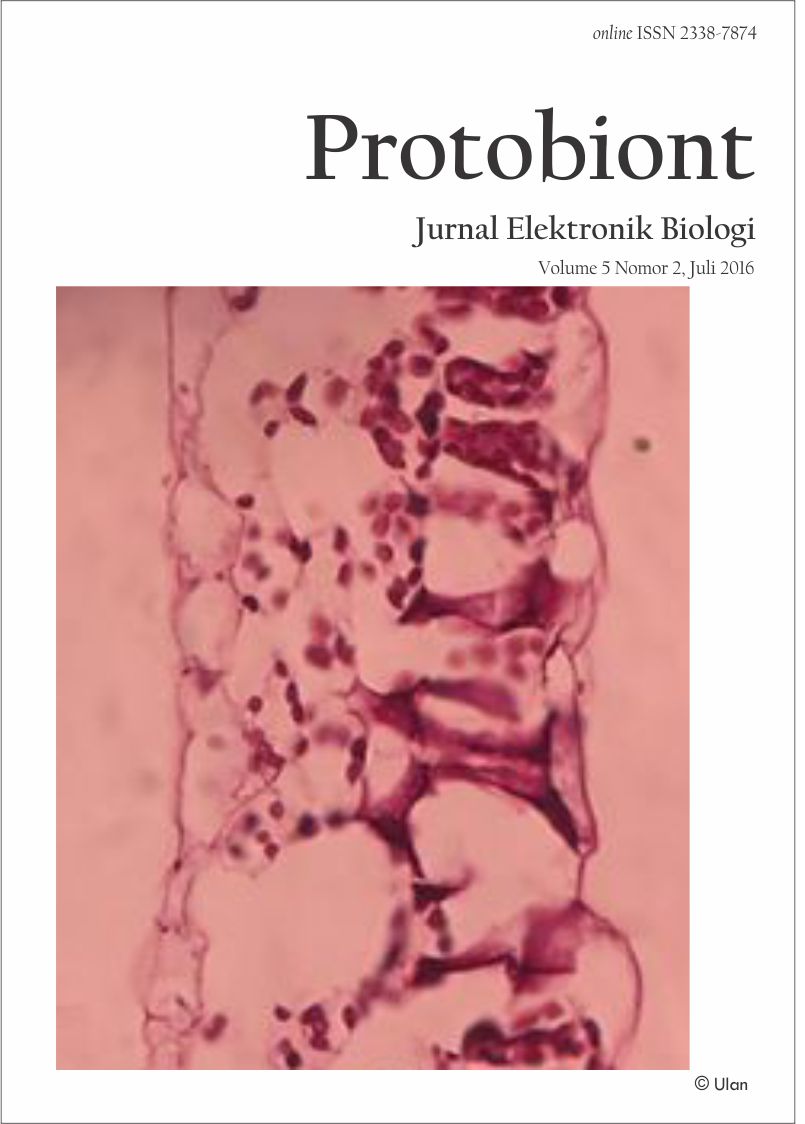
Plants require proper environtmental conditions for growth and development. One of the environmental conditions that put pressure on plants that may result in environmental stress is salinity. Plants will undergo morphological and anatomical changes to be able to adapt to saline environments. The long beans (Vigna sinensis (L.), var. BCA 02) which were used in this research are varieties that are sensitive to salinity and cultivated in the area of Rasau Jaya, West Kalimantan. This research aims to find out the anatomical structure of the vegetative organs of long beans (V. sinensis (L.), var. BCA 02) at the NaCl levels of 2,000ppm, 3,000 ppm and 5,000 ppm. The research was carried out from September to November 2015. The preparations of cross section of vegetative organs (roots, stems and leaves) were made using a paraffin method. Research findings showed that the addition of NaCl caused changes in morphological and anatomical structure of the vegetative organs of long beans which included epidermal thickness, cortex, mesophyll and vascular tissue.
Downloads
Published
2016-07-14
Issue
Section
Articles
License
Authors who publish with this journal agree to the following terms:
- Authors retain copyright and grant the journal right of first publication with the work simultaneously licensed under a Creative Commons Attribution-ShareAlike License that allows others to share the work with an acknowledgement of the work's authorship and initial publication in this journal.
- Authors are not restricted by the journal from entering into separate, additional contractual arrangements for the non-exclusive distribution of the journal's published version of the work (e.g., posting it to an institutional repository or publishing it in a book), with an acknowledgement of its initial publication in this journal.
- Authors are permitted and encouraged to post their work online (e.g., in institutional repositories or on their website) after its publication in this journal. This approach aims to safeguard against potential plagiarism or unauthorized use of unpublished manuscripts, as outlined in the submission guidelines which state that this journal does not accept previously published manuscripts.
