
Potensi Ekstrak Daun Paku Resam (Gleichenia linearis Burm.) Sebagai Bioherbisida Pengendali Gulma Rumput Grinting (Cynodon dactylon (L.) Pers)
DOI:
https://doi.org/10.26418/protobiont.v6i2.20798Keywords:
Bioherbicide, Gleichenia linearis, Cynodon dactylonAbstract
Gleichenia linearis is a wide leaf weed which contains chemical compound such as flavonoid, allelochemical, triterpenoid, saponin, tannin, alkaloid and steroid that can inhibit the growth of other plants as a bioherbicide. This study aims to determine the concentration of G. linearis leaf extract on germination and growth of seedling weed Cynodon dactylon. This study was conducted in a laboratory and a screen house of Biology Department of Mathematics and Natural Science Faculty in Chemical and Soil Fertility Laboratory of Agriculture Faculty and in Wood Technology Laboratory of Forestry Faculty of University of Tanjungpura Pontianak from September to November 2016. The study employed completely randomized design with 5 replicates consisting control, 0,1; 0,2 and 0,3 gr/ml (germination) than control, 0,1 and 0,2 gr/ml (growt). The research findings showed that effective concentration that can inhibit germination of weed C. dactylon is 0,3 gr/ml concentration and inhibit the growth of other plants is 0,2 gr/ml concentration.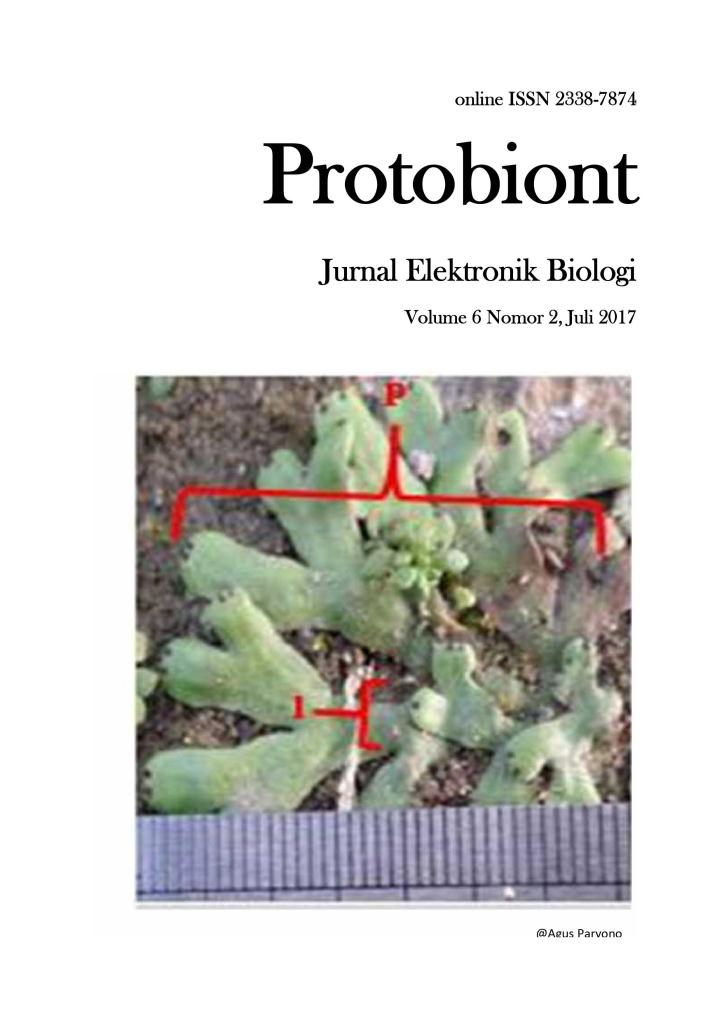
Downloads
Published
2017-07-13
Issue
Section
Articles
License
Authors who publish with this journal agree to the following terms:
- Authors retain copyright and grant the journal right of first publication with the work simultaneously licensed under a Creative Commons Attribution-ShareAlike License that allows others to share the work with an acknowledgement of the work's authorship and initial publication in this journal.
- Authors are not restricted by the journal from entering into separate, additional contractual arrangements for the non-exclusive distribution of the journal's published version of the work (e.g., posting it to an institutional repository or publishing it in a book), with an acknowledgement of its initial publication in this journal.
- Authors are permitted and encouraged to post their work online (e.g., in institutional repositories or on their website) after its publication in this journal. This approach aims to safeguard against potential plagiarism or unauthorized use of unpublished manuscripts, as outlined in the submission guidelines which state that this journal does not accept previously published manuscripts.
