
Pertumbuhan Kalus Tanaman Markisa (Passiflora sp.) dengan Penambahan Naphtalene Acetic Acid (NAA) dan 6-Benzyl Amino Purine (BAP)
DOI:
https://doi.org/10.26418/protobiont.v6i2.20801Keywords:
Passiflora sp., callus, NAA (Naphtalene Acetic Acid), BAP (6-Benzyl Amino Purine).Abstract
Passiflora sp. is one of the herbaceous plants whose leaves contain secondary metabolites. This plant is widely exploited by the community for use as pharmaceuticals. Accordingly another alternative is required to isolate its metabolites and one of the alternatives that can be applied is technique of tissue culture. The purpose of this study is to investigate the effect of NAA, BAP and combination of NAA and BAP on callus growth of Passiflora sp.. This study is conducted in Aloe Vera Center Laboratory of Pontianak. Completely Randomized Design with 4 concentration levels of NAA and BAP specifically 0 M, 10-7 M, 5x10⁻⁷ M and 10-6 M was employed 3 times and 48 units of experiments were obtained. The findings indicate that all treatments yield callus with dense texture and generate a variety of color specifically tawny, green and greenish white.NAA, BAP and combination of NAA and BAP has no significant effect on the average time of callus growth. The combination of NAA and BAP has substantial effect on the average of callus wet basis. Concentration of NAA 5x10⁻⁷+ BAP 10-6 M and NAA 5x10⁻⁷+ BAP 10-7 M produce the highest wet basis in particular 2,4380 g and 2,2420 g. the combination of NAA and BAP has remarkable effect on callus dry basis and concentration of NAA 5x10⁻⁷+ BAP 10-6 M produce the highest average of dry basis particularly 0,0160 g.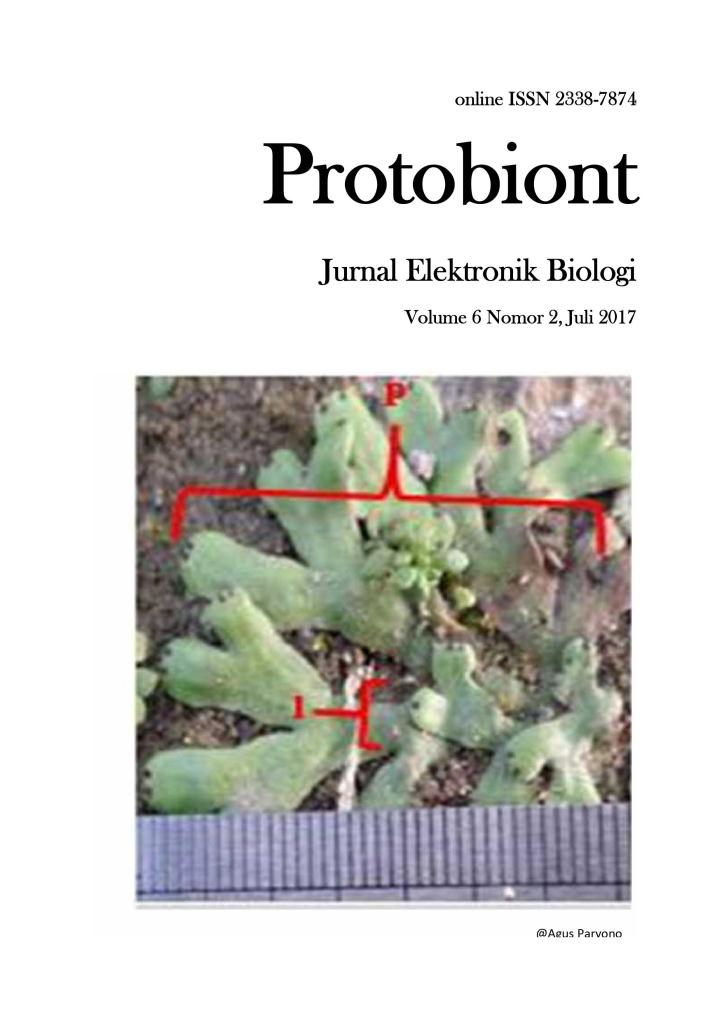
Downloads
Published
2017-07-13
Issue
Section
Articles
License
Authors who publish with this journal agree to the following terms:
- Authors retain copyright and grant the journal right of first publication with the work simultaneously licensed under a Creative Commons Attribution-ShareAlike License that allows others to share the work with an acknowledgement of the work's authorship and initial publication in this journal.
- Authors are not restricted by the journal from entering into separate, additional contractual arrangements for the non-exclusive distribution of the journal's published version of the work (e.g., posting it to an institutional repository or publishing it in a book), with an acknowledgement of its initial publication in this journal.
- Authors are permitted and encouraged to post their work online (e.g., in institutional repositories or on their website) after its publication in this journal. This approach aims to safeguard against potential plagiarism or unauthorized use of unpublished manuscripts, as outlined in the submission guidelines which state that this journal does not accept previously published manuscripts.
