
Struktur Komunitas Makrofita Akuatik di Sungai Embau Kecamatan Hulu Gurung Kabupaten Kapuas Hulu
DOI:
https://doi.org/10.26418/protobiont.v6i2.20803Keywords:
Aquatic macrophyte, Cover Area Transect, emergent, submerged, Fissidens toxifolius L. VhalAbstract
Aquatic macrophyte is one of macro plants that grows in or in near that water. The study aimed to know structure of aquatic macrophyte community plants in Embau river district of Hulu Gurung, Kapuas Hulu Regency. The research sample were taken in april 2016 using cover area transect. There are 15 species from 12 families of aquatic macrophytes found in the research site. Thirteen types of these plants are emergent such as Calla sp., Cyperus pilosus L., Chiloscypus polyanthos L., Dichodontium sp., Donax canniformes, Eleocharis pervula R.Br, Fissidens toxifolius L. Vhal, Fluminea festutacea, Eleusine indica (L) Gaertn, Homalomena sp., Monosolenium terenum, Polygonum sp. dan Rosmarinus sp. The two types of submerged plants found in the sampling site are Glossostigma sp., and Elodea sp. Species of F. toxifolius L. Vhal is one of aquatic macrophytes that had the highest cover area transect (CAT) with 18,1% while Eleusine indica (L) Gaertn had the lowest CAT with 1,39%. According diversity index aquatic macrophyte in Embau river was moderate (H"™= 1,18-1,8), Index of dominace was low (C= 0,21-0,44) and high level of evenest index (E= 0,44-0,69). The Embau river is the highest polluted heavy metal of Plumbum (Pb2+) in sediment with 13,4 mg/l.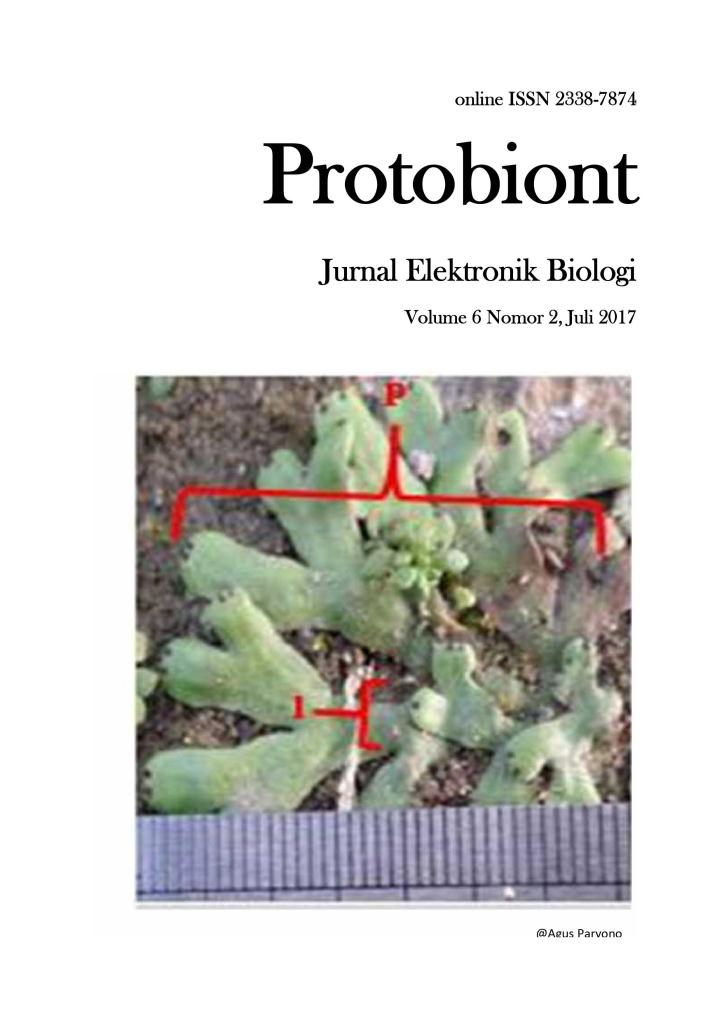
Downloads
Published
2017-07-13
Issue
Section
Articles
License
Authors who publish with this journal agree to the following terms:
- Authors retain copyright and grant the journal right of first publication with the work simultaneously licensed under a Creative Commons Attribution-ShareAlike License that allows others to share the work with an acknowledgement of the work's authorship and initial publication in this journal.
- Authors are not restricted by the journal from entering into separate, additional contractual arrangements for the non-exclusive distribution of the journal's published version of the work (e.g., posting it to an institutional repository or publishing it in a book), with an acknowledgement of its initial publication in this journal.
- Authors are permitted and encouraged to post their work online (e.g., in institutional repositories or on their website) after its publication in this journal. This approach aims to safeguard against potential plagiarism or unauthorized use of unpublished manuscripts, as outlined in the submission guidelines which state that this journal does not accept previously published manuscripts.
