
Pertumbuhan dan Karakter Anatomi Mimosa Air (Neptunia oleracea Lour.) pada Air yang Terpapar Logam Aluminium (Al)
DOI:
https://doi.org/10.26418/protobiont.v6i2.20816Keywords:
phytoremediation, Neptunia oleracea, heavy metals, aluminiumAbstract
Water mimosa (Neptunia oleracea Lour.) is one kind of aquatic plant which is potential to have adaptive ability to heavy metal exposure in water. Among heavy metals that can contaminate water is aluminum originated from the use of aluminum sulfate [Al2(SO4)3], commonly known as alum for water clarifying. The research ran for 2 months, from January to March 2017. The research used Completely Randomized Design which consisted of six aluminium sulfate concentration treatments: control, 50, 75, 100, 125, and 150 ppm. The research findings showed that aluminum had influence on N. oleracea morphologically, which was marked by the leaves becoming yellowish and the roots becoming softer. Anatomically, seen from the slide of the root, the treatment using the highest concentration resulted in a shrinkage of stele area up to 69,43%. In the slide of the plant stem, the aerenchyma was more distantly spread, and from the slide of the leaf there was a color change of the tissue to be brown. Nevertheless, N. oleracea still could survive in water with aluminum concentration of 150 ppm.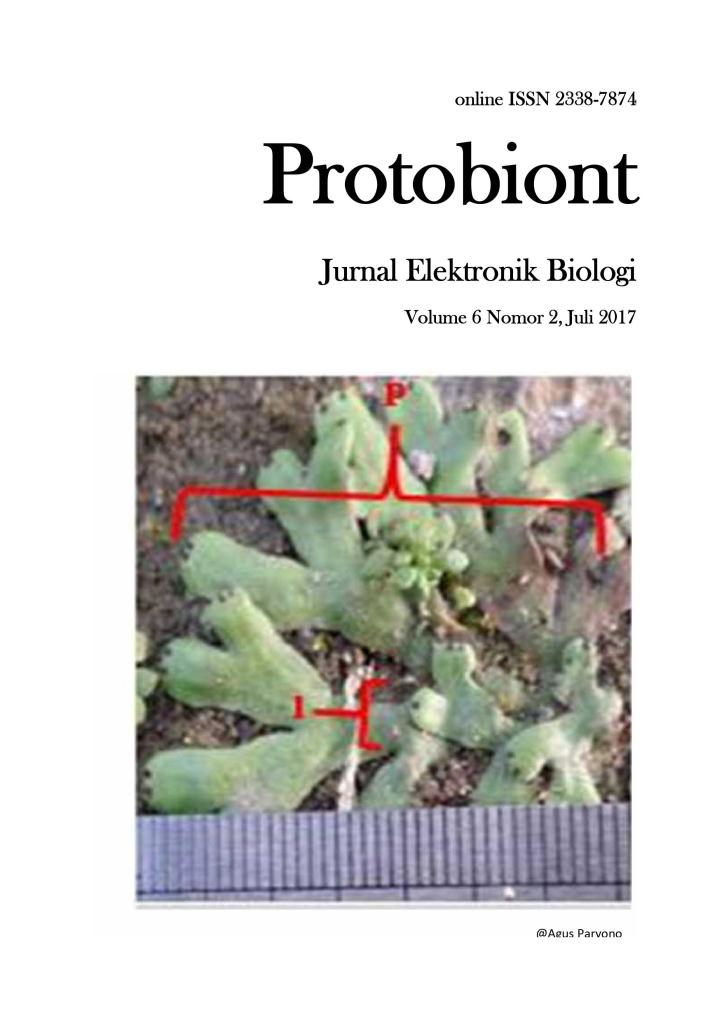
Downloads
Published
2017-07-14
Issue
Section
Articles
License
Authors who publish with this journal agree to the following terms:
- Authors retain copyright and grant the journal right of first publication with the work simultaneously licensed under a Creative Commons Attribution-ShareAlike License that allows others to share the work with an acknowledgement of the work's authorship and initial publication in this journal.
- Authors are not restricted by the journal from entering into separate, additional contractual arrangements for the non-exclusive distribution of the journal's published version of the work (e.g., posting it to an institutional repository or publishing it in a book), with an acknowledgement of its initial publication in this journal.
- Authors are permitted and encouraged to post their work online (e.g., in institutional repositories or on their website) after its publication in this journal. This approach aims to safeguard against potential plagiarism or unauthorized use of unpublished manuscripts, as outlined in the submission guidelines which state that this journal does not accept previously published manuscripts.
