
Uji Antagonis Isolat Jamur Rizosfer Lokal Terhadap Phytophthora sp. Im5 dari Pangkal Batang Tanaman Jeruk Siam (Citrus nobilis var. microcarpa)
DOI:
https://doi.org/10.26418/protobiont.v6i2.20834Keywords:
antagonistic test, brown rot gummosis, (Citrus nobilis), Phytophthora sp.Abstract
Fungi isolate from members of species of Phytophthora sp. Im5 is one of the pathogens that cause Brown Rot Gummosis on siam citrus plant (Citrus nobilis var. microcarpa). The control of plant pathogens is biologically done by utilizing biological agents in form of rhizosphere fungi that have antagonistic activity. This research aims to determine the antagonistic activity of rhizosphere fungi ( isolate : Mucor sp. Im1, Penicillium sp. Im2, Penicillium sp. Im3, and Trichoderma sp. Im4 ) in controlling fungi isolate of species of Phytophthora sp.Im5. Isolation, identification and antagonistic test were conducted at Microbiology Laboratory, Faculty of Mathematics and Science of Tanjungpura University Pontianak from February to June 2017. This research used Completely Randomized Design with five treatments and three replications which obtained a total of 15 experimental units. The antagonistic test used double test methods. The highest antagonistic activity in suppressing the growth of fungi isolate Phytophthora sp. Im5 is fungi isolate Mucor sp. Im1 with a percentage of 45.48%.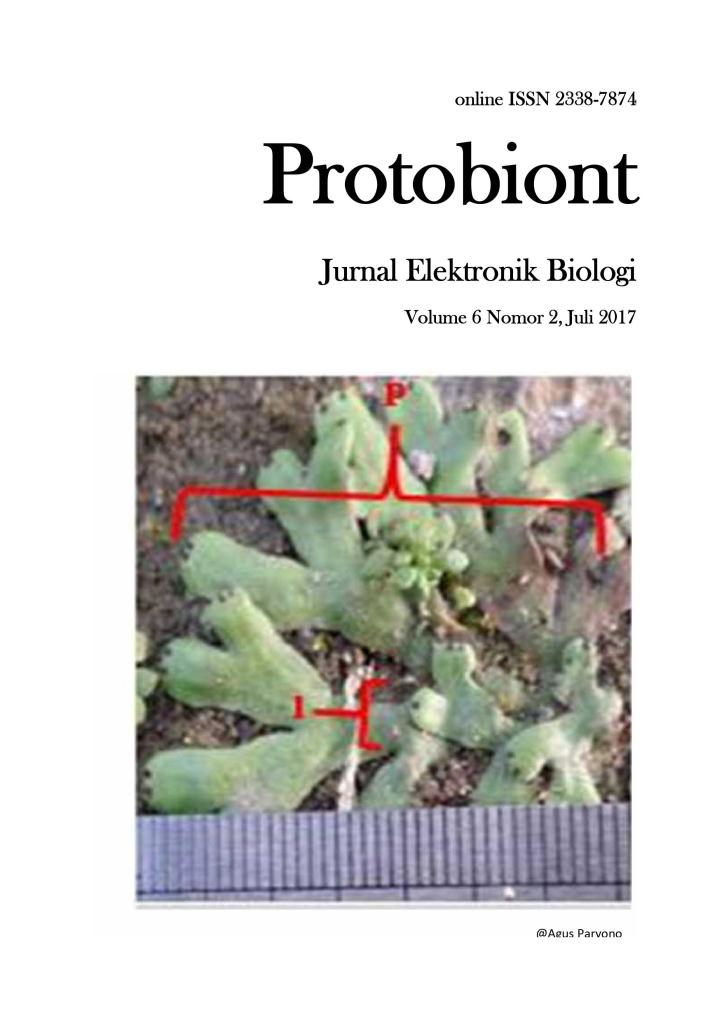
Downloads
Published
2017-07-14
Issue
Section
Articles
License
Authors who publish with this journal agree to the following terms:
- Authors retain copyright and grant the journal right of first publication with the work simultaneously licensed under a Creative Commons Attribution-ShareAlike License that allows others to share the work with an acknowledgement of the work's authorship and initial publication in this journal.
- Authors are not restricted by the journal from entering into separate, additional contractual arrangements for the non-exclusive distribution of the journal's published version of the work (e.g., posting it to an institutional repository or publishing it in a book), with an acknowledgement of its initial publication in this journal.
- Authors are permitted and encouraged to post their work online (e.g., in institutional repositories or on their website) after its publication in this journal. This approach aims to safeguard against potential plagiarism or unauthorized use of unpublished manuscripts, as outlined in the submission guidelines which state that this journal does not accept previously published manuscripts.
