
Aplikasi Pupuk Organik Cair (POC) Kotoran Kambing Difermentasikan Dengan EM4 Terhadap Pertumbuhan Dan Produktivitas Tanaman Cabai Rawit (Capsicum frutescents L.) Var. Bara
DOI:
https://doi.org/10.26418/protobiont.v6i3.22473Keywords:
Capsicum frutescens L., EM4, goat dung (feses), liquid organic fertilizerAbstract
Cayenne pepper (Capsicum frutescens L.) is a horticulture plant which has a high economic value in Indonesia. One of the varieties which is quite popular among consumers is Bara variety. The liquid organic fertilizer (POC) from goat dung (feces) fermented by EM4 has contains a relatively equal nutrient of N, P, K, and C-organic. This research aims to identifying the effects and the concentration of POC from goat dung fermented by EM4 which can produce the best growth and productivity of cayenne pepper in Bara variety. The research was conducted for four months starting from January to April 2017 in a Laboratory and home screen at Biology departement of Mathematic and Natural Sciences Faculty in Tanjungpura University. The research was also carried out in a chemical and soil fertility laboratory of Agricultural Faculty. It used a Randomised Complete Design (RAL) with four levels of treatments, i.e. A0 = 0 (control), A1 = POC 10%, A2 = POC 20% and A3 = POC 30%. The data was then analysed by using ANOVA test (Analysis of variance). Result of the test which have a significant effect continues to a Duncan"™s test at the level of 5%. Results show that the concentration of POC 20% provides the best growth and productivity on cayenne Pepper in Bara variety towards the average plant height by 41,60 cm, branch numbers by 3,2, the number of fruits by 50,8, fruit total weight by 42,67 gram and the total number seeds by 13,8.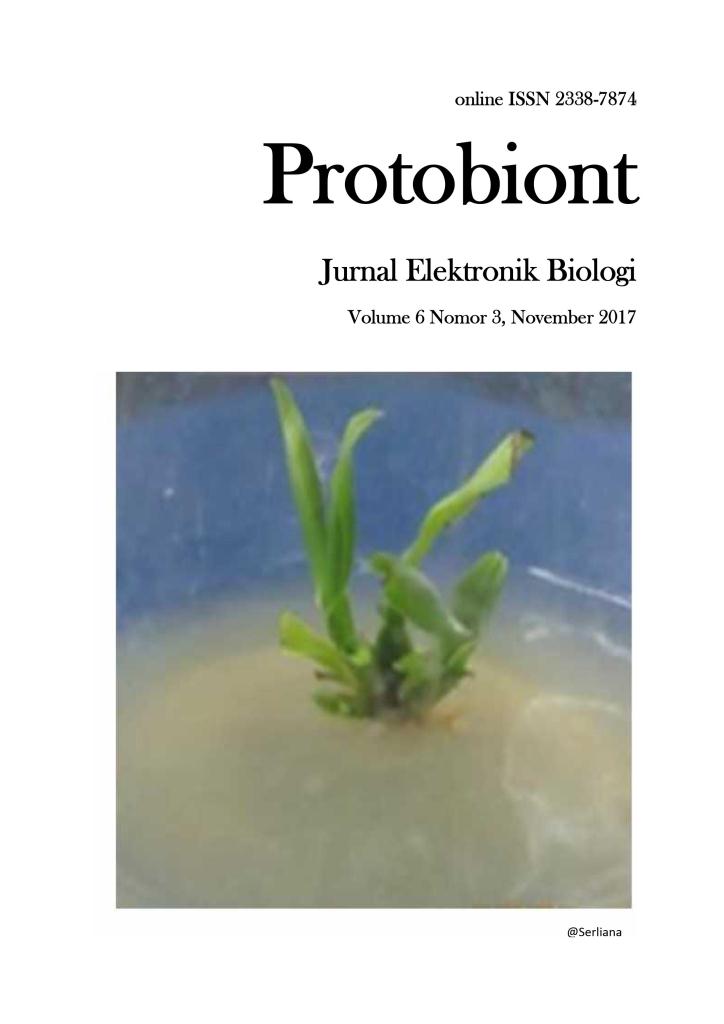
Downloads
Published
2019-03-19
Issue
Section
Articles
License
Authors who publish with this journal agree to the following terms:
- Authors retain copyright and grant the journal right of first publication with the work simultaneously licensed under a Creative Commons Attribution-ShareAlike License that allows others to share the work with an acknowledgement of the work's authorship and initial publication in this journal.
- Authors are not restricted by the journal from entering into separate, additional contractual arrangements for the non-exclusive distribution of the journal's published version of the work (e.g., posting it to an institutional repository or publishing it in a book), with an acknowledgement of its initial publication in this journal.
- Authors are permitted and encouraged to post their work online (e.g., in institutional repositories or on their website) after its publication in this journal. This approach aims to safeguard against potential plagiarism or unauthorized use of unpublished manuscripts, as outlined in the submission guidelines which state that this journal does not accept previously published manuscripts.
