
Pertumbuhan Tanaman Bayam Kuning (Amaranthus blitum L.) dengan Pemberian Pupuk Organik Cair Dari Kulit Kecambah Kacang Hijau (Vigna radiata L.)
DOI:
https://doi.org/10.26418/protobiont.v6i3.22477Keywords:
Amaranthus blitum, Liquid Organic Fertilizer (LOF), The Hulls of Mung Bean SproutsAbstract
Yellow spinach (A. blitum L.) is a rarely cultivated plant in West Kalimantan. To overcome this situation, farmers can use Liquid Organic Fertilizer (LOF). This research aims to find out the effects of LOF from The Hulls of Mung Bean Sprouts towards the growth of Yellow Spinach Plant and to find out the concentration of LOF from The Hulls of Mung Bean Sprouts which generates the highest growth on yellow spinach plant. This research was conducted from February to April 2017 in Biology Laboratory of Mathematics and Natural Science Faculty, Tanjungpura University Pontianak. This research used completely Randomized Design which consisted of 5 levels of treatment that are without LOF (control), LOF 55 (P1), LOF 60 (P2), LOF 65 (P3), and LOF 70 ml/L (P4). Each treatment was given 4 times so there were 20 units of experiment. The results show that the giving of LOF with 60 ml/L of concentration offered a significant effect towards all growth parameters. The optimum results of the average height of the plant was 20.17 cm, the number of leaves was 17.25, the shoot wet weight was 6.65 g, the shoot dry weight was 0.69 g, the root wet weight was 16 g, and the root dry weight was 9.50 g.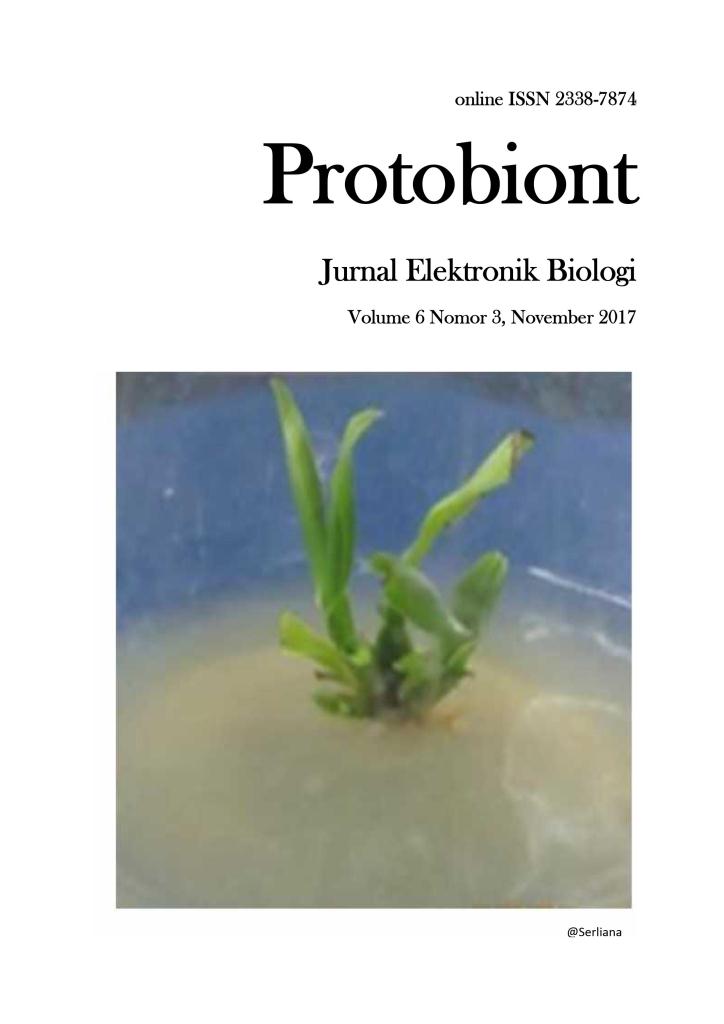
Downloads
Published
2019-03-19
Issue
Section
Articles
License
Authors who publish with this journal agree to the following terms:
- Authors retain copyright and grant the journal right of first publication with the work simultaneously licensed under a Creative Commons Attribution-ShareAlike License that allows others to share the work with an acknowledgement of the work's authorship and initial publication in this journal.
- Authors are not restricted by the journal from entering into separate, additional contractual arrangements for the non-exclusive distribution of the journal's published version of the work (e.g., posting it to an institutional repository or publishing it in a book), with an acknowledgement of its initial publication in this journal.
- Authors are permitted and encouraged to post their work online (e.g., in institutional repositories or on their website) after its publication in this journal. This approach aims to safeguard against potential plagiarism or unauthorized use of unpublished manuscripts, as outlined in the submission guidelines which state that this journal does not accept previously published manuscripts.
