
Respon Pertumbuhan Sorghum (Sorghum bicolor (L.)) Varietas Kawali Pada Tanah Bekas Pertambangan Emas Rakyat
DOI:
https://doi.org/10.26418/protobiont.v6i3.22496Keywords:
growth, sorghum (Sorghum bicolor (L.)), community gold miningAbstract
Sorghum (Sorghum bicolor (L.)) is a cereal food plantswhich can be utilized as heavy metal hyperacumulating plant. The research aims to find out the response of the growth of sorghum that cultivated on post gold mining soil (tailing). This research was conducted for 3 months from November 2016 to January 2017. It was done in the Greenhouse and Biology of Biology Departement in MIPA Faculity Universitas Tanjungpura Pontianak. Soil analysis was done in PT. Sucofindo Pontianak. This research used Completely Randomized Design (RAL) with five variations of soil sampling distance, namely P1 = 0 m, P2 = 75 m, P3 = 150 m, P4 = 225 m, P5 = 300 m. Each treatment was repeated three times, so there were 15 experimental units. The results show that sorghum can grow on soil sampling at distance 0- 300 m, but the best growth is at distance of 300 m. The further the distance from the tailing center, the vhiger the number of its leaves, height, wet weight, and dry weight.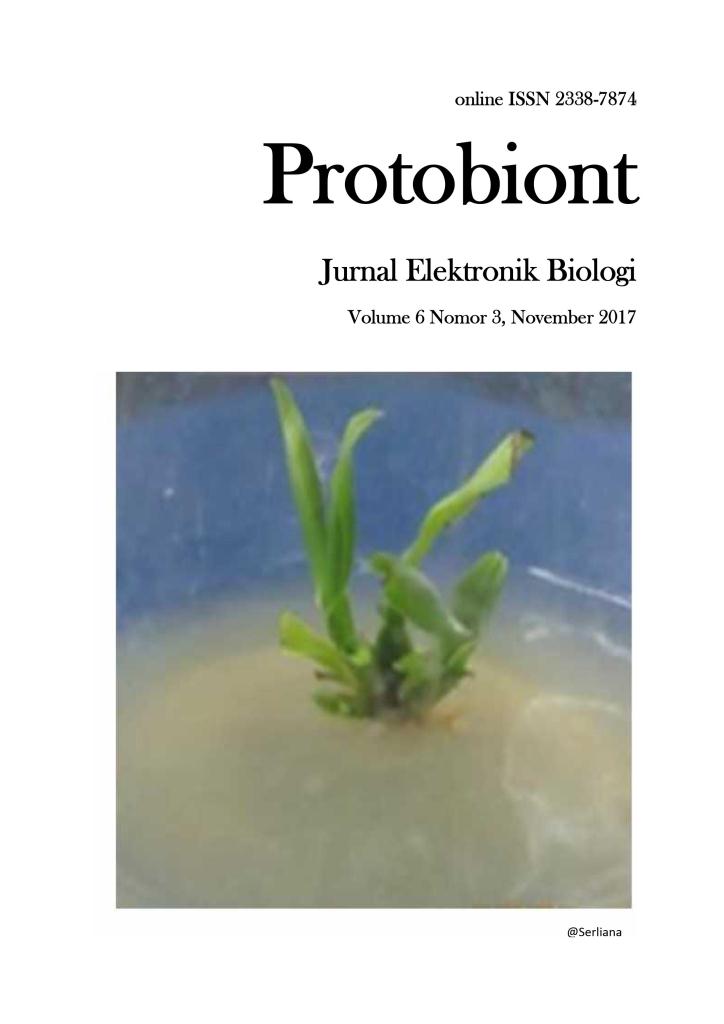
Downloads
Published
2019-03-19
Issue
Section
Articles
License
Authors who publish with this journal agree to the following terms:
- Authors retain copyright and grant the journal right of first publication with the work simultaneously licensed under a Creative Commons Attribution-ShareAlike License that allows others to share the work with an acknowledgement of the work's authorship and initial publication in this journal.
- Authors are not restricted by the journal from entering into separate, additional contractual arrangements for the non-exclusive distribution of the journal's published version of the work (e.g., posting it to an institutional repository or publishing it in a book), with an acknowledgement of its initial publication in this journal.
- Authors are permitted and encouraged to post their work online (e.g., in institutional repositories or on their website) after its publication in this journal. This approach aims to safeguard against potential plagiarism or unauthorized use of unpublished manuscripts, as outlined in the submission guidelines which state that this journal does not accept previously published manuscripts.
