
Pertumbuhan Anggrek Hitam (Coelogyne pandurata Lindl.) secara In Vitro Dengan Penambahan Ekstrak Tomat (Solanum lycopersicum L) Dan Benzyl Amino Purine (BAP)
DOI:
https://doi.org/10.26418/protobiont.v6i3.22500Keywords:
Growth, Coelogyne pandurata, tomato extract, BAPAbstract
Black orchid (Coelogyne pandurata Lindl.) Is an endemic germplasm Kalimantan. This orchid is in great demand because of the potential to have high economic value. Consequently, it is often overexploited, yet it has not been widely cultivated. This research aims to find out the effect of augmenting tomato extract and benzyl amino purine (BAP) in the growing of black orchid. This research started from January to March 2017 in Tissue Culture Laboratory Aloe Vera Center (AVC) Pontianak. This research used Completely Randomized Design (CRD) with 2 treatment factors and 3 repetition. The first factor was tomato extract (0%; 7,5%; 10%; 12,5%) and second factor was BAP (0 M; 10-6 M; 10-7 M). The results show that the single factor of tomato extract and BAP and the combination factor also did not have a real effect on the time shoots appear and the number of leaves. The interaction factor of tomato extract and BAP did not have a real effect on the number of shoots, but the single factor of tomato extract and BAP had a real effect on the number of shoots and single factor of BAP had a real effect on the number of leaves. The highest number of shoots was 3,33 in the treatment of tomato extract 7.5% and 1.33 in the treatment of BAP of 10-6 M. The highest number of leaves was 11.33 sheets in the treatment of tomato extract of 12,5% and the lowest number of leaves was in the treatment of tomato extract of 10% and BAP of 10-6 M with an average of 3,00 sheets.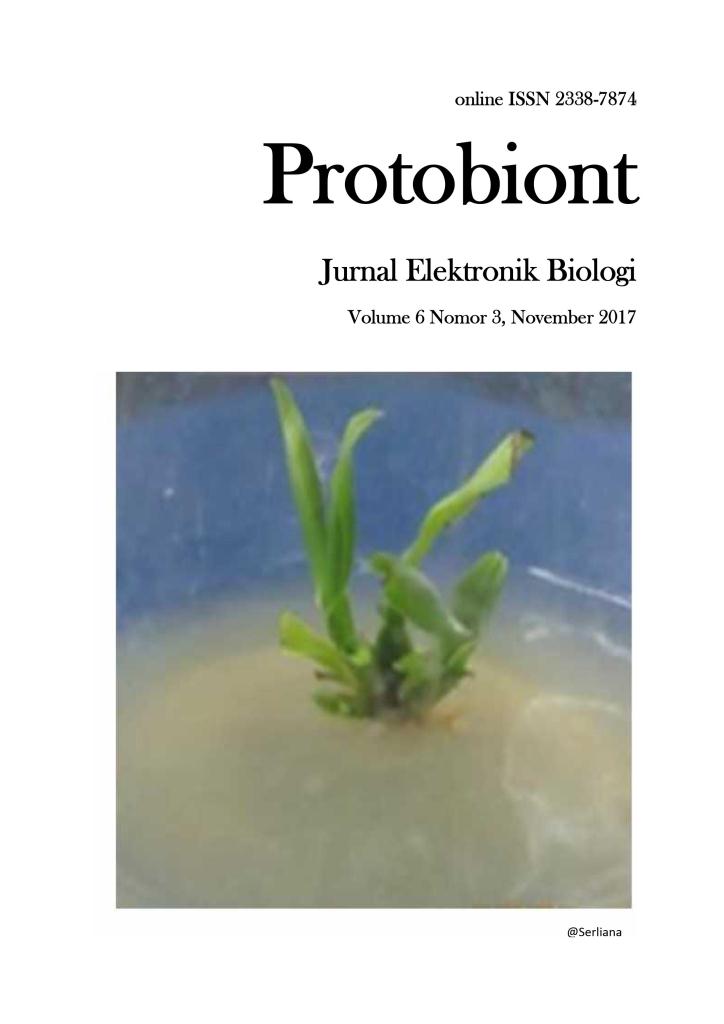
Downloads
Published
2019-03-19
Issue
Section
Articles
License
Authors who publish with this journal agree to the following terms:
- Authors retain copyright and grant the journal right of first publication with the work simultaneously licensed under a Creative Commons Attribution-ShareAlike License that allows others to share the work with an acknowledgement of the work's authorship and initial publication in this journal.
- Authors are not restricted by the journal from entering into separate, additional contractual arrangements for the non-exclusive distribution of the journal's published version of the work (e.g., posting it to an institutional repository or publishing it in a book), with an acknowledgement of its initial publication in this journal.
- Authors are permitted and encouraged to post their work online (e.g., in institutional repositories or on their website) after its publication in this journal. This approach aims to safeguard against potential plagiarism or unauthorized use of unpublished manuscripts, as outlined in the submission guidelines which state that this journal does not accept previously published manuscripts.
