
Pertumbuhan Stek Batang Nepenthes reinwardtiana Miq. Setelah Direndam Dengan Urin Kambing
DOI:
https://doi.org/10.26418/protobiont.v7i1.23613Keywords:
Nepenthes reinwardtiana Miq., Conservation, Stem Cuttings, Goat urine, AuxinAbstract
Nepenthes reinwardtiana Miq. is one of the species of Nepenthes found in west Borneo where its population in nature is declining. Ex-situ conservation efforts by cultivating vegetatively through stem cuttings need to be done to overcome the extinction of N.reinwardtiana. One of the factors that determines the growth of cuttings is the content of the external growth regulator namely auxin. One of the sources of organic auxin that can be used is goat urine. This research was conducted to find out the effects of goat urine on the growth of stem cuttings of N.reinwardtiana and to find out the concentration of goat urine that provides the best growth on N.reinwardtiana stem cuttings. The method used is completely randomized design with 4 treatments which is goat urine concentration of 0,15,30 and 40% , each treatment is repeated 3 times so that 12 units of experiment were obtained. The results show that immersion of goat urine has significant effect on the time of shoot, the number of roots and height of the plant but does not provide the number of shoots. Goat urine concentration of 15% produces that fastest shoot growth namely 11.23 days while the concentration of 30% gives the best result on the number of roots as many 2 pieces and the height of the plant namely 4.17 cm.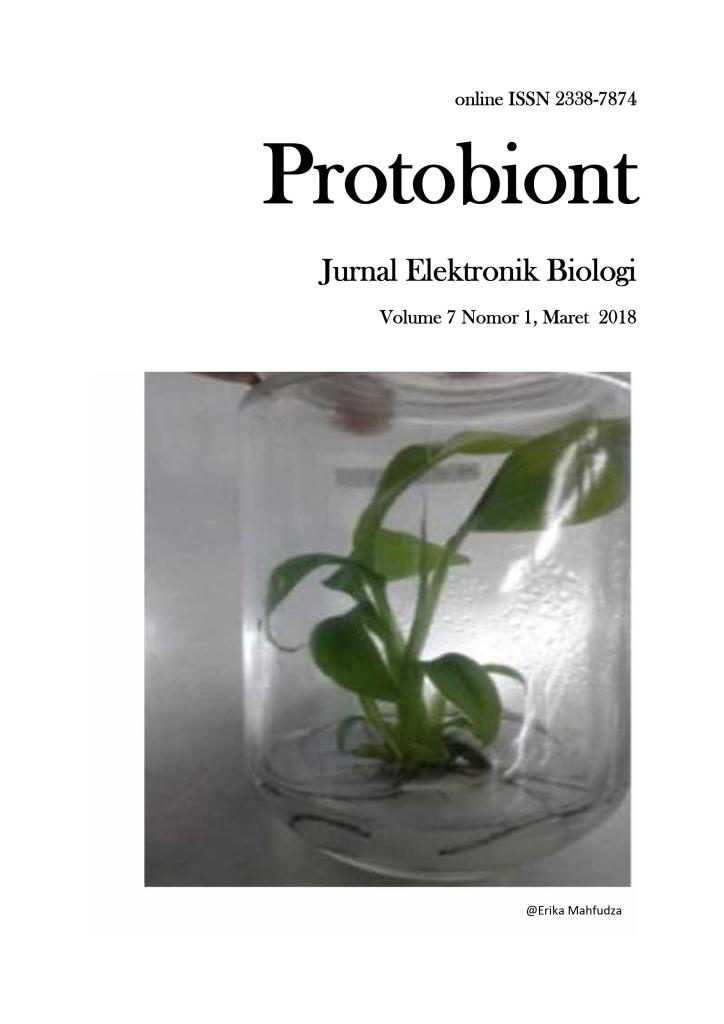
Downloads
Published
2018-01-12
Issue
Section
Articles
License
Authors who publish with this journal agree to the following terms:
- Authors retain copyright and grant the journal right of first publication with the work simultaneously licensed under a Creative Commons Attribution-ShareAlike License that allows others to share the work with an acknowledgement of the work's authorship and initial publication in this journal.
- Authors are not restricted by the journal from entering into separate, additional contractual arrangements for the non-exclusive distribution of the journal's published version of the work (e.g., posting it to an institutional repository or publishing it in a book), with an acknowledgement of its initial publication in this journal.
- Authors are permitted and encouraged to post their work online (e.g., in institutional repositories or on their website) after its publication in this journal. This approach aims to safeguard against potential plagiarism or unauthorized use of unpublished manuscripts, as outlined in the submission guidelines which state that this journal does not accept previously published manuscripts.
