
Perbanyakan Tunas Pisang Cavendish (Musa acuminata L.) Secara In Vitro dengan Penambahan Naphthalene Acetic Acid (NAA) dan Air Kelapa
DOI:
https://doi.org/10.26418/protobiont.v7i1.23632Keywords:
tissue culture, Musa acuminata, NAA, Coconut waterAbstract
Cavendish banana (Musa acuminata L.) is classified into Musaceae Family which is originally from Southeast Asian. The superiority of this banana is its size which is bigger and it has 10 hand of bananas. The addition of growth regulator (zpt) in the tissue culture medium is a vital component in the process of the growth and the development of the plants in vitro. This research aims at identifying the influence of NAA and coconut water toward the multiplication of cavendish banana through in vitro. The research was conducted for three months since January to March of 2017 in the local Laboratory of Regional Technical Implementation Unit (UPTD) of Aloe Vera Agribisness Centre (AVC) at Agriculture, Fishery, and Forestry Agency of the Pontianak, North Pontianak sub-district. The research empoyed a completely randomised design with four level factors of NAA (N) with concentration of 0 M (N1), 10-7 M (N2), 5x10⁻⁶ M (N3), 10-6 M (N4) and coconut water (A) with concentration of % (A1), 10% (A2), 15% (A3) and 20% (A4). The results show that the single N2 treatment could gain the average rates of crown and leaves by 9.33 and the treatment of N4A2 could provide the average rate of shoot by 1,33.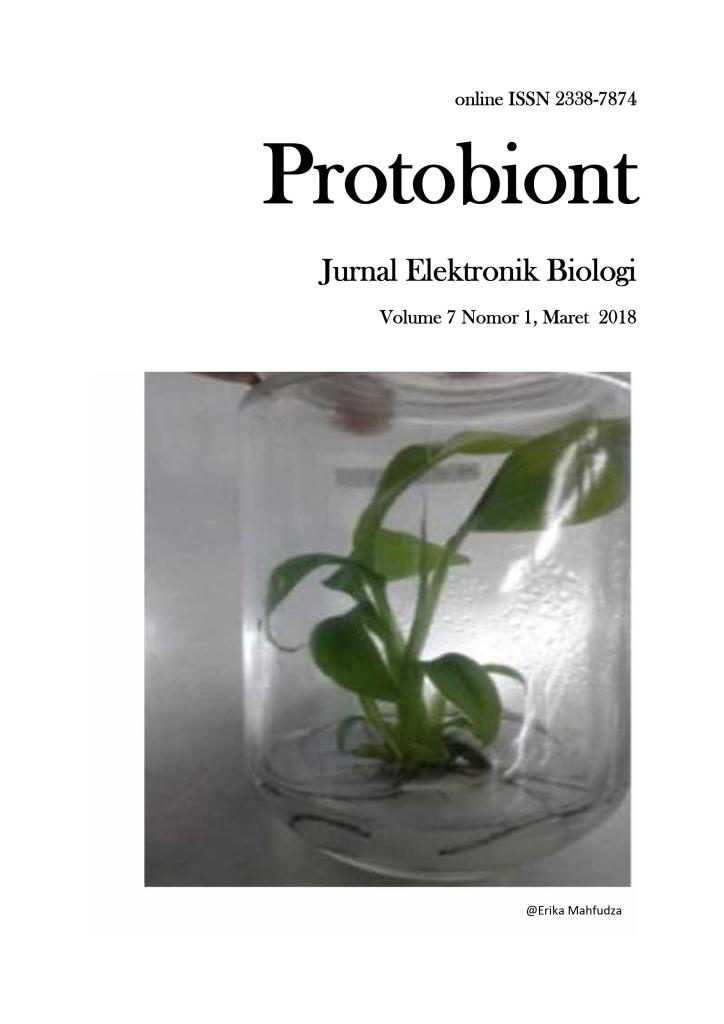
Downloads
Published
2018-01-12
Issue
Section
Articles
License
Authors who publish with this journal agree to the following terms:
- Authors retain copyright and grant the journal right of first publication with the work simultaneously licensed under a Creative Commons Attribution-ShareAlike License that allows others to share the work with an acknowledgement of the work's authorship and initial publication in this journal.
- Authors are not restricted by the journal from entering into separate, additional contractual arrangements for the non-exclusive distribution of the journal's published version of the work (e.g., posting it to an institutional repository or publishing it in a book), with an acknowledgement of its initial publication in this journal.
- Authors are permitted and encouraged to post their work online (e.g., in institutional repositories or on their website) after its publication in this journal. This approach aims to safeguard against potential plagiarism or unauthorized use of unpublished manuscripts, as outlined in the submission guidelines which state that this journal does not accept previously published manuscripts.
