
Variasi Morfometrik dan Pengelompokan Spesies Kantong Semar (Nepenthes Spp.) di Desa Simpang Kasturi Kecamatan Mandor
DOI:
https://doi.org/10.26418/protobiont.v7i2.25295Keywords:
Nepenthes, Cluster Analysis, MorfometricAbstract
Nepenthes spp. is one of the ornamental plants in Indonesia that has much uniquenesses on its pitcher cup in shape and colour. The purpose of this research is to recognize the variety of morphometric characters and to know the grouping of Kantong Semar species (Nepenthes spp.) in Simpang Kasturi Village, Mandor District. The study was conducted for 3 months from October to December 2017 at Simpang Kasturi Village Forest, Mandor District. Identification, data processing, and the making of herbarium were done in Biology Laboratory of Biology Department, Mathematics and Natural Science Faculty of Tanjungpura University, Pontianak. The research method was done using the survey method following by sampling processes performed by taking samples of leaves, stems, and pitcher cup. Samples then were observed based on morphological characteristics of leaves, tendrils, stems and pitcher cup. Furthermore, collected data were analyzed using cluster analysis (grouping analysis) with SPSS 21 program. The results of this study found 5 individuals from 4 species of Nepenthes which have different morphometric characters among themselves. The most various morphological character among the species is the morphological character of the pitcher cup. Nepenthes rafflesiana has the largest pitcher cup size while Nepenthes gracilis has the smallest one size. Based on the coefficient value, the most significant grouping is Nepenthes rafflesiana with Nepenthes mirabilis, while the closest one is Nepenthes ampullaria 1 with Nepenthes ampullaria 2.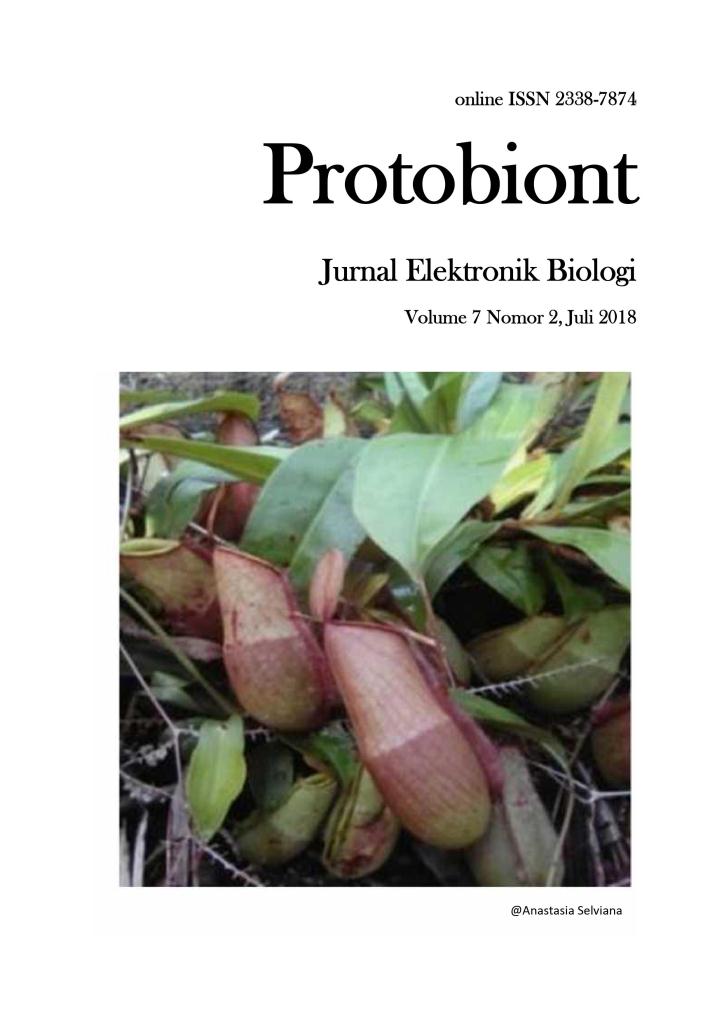
Downloads
Published
2018-04-16
Issue
Section
Articles
License
Authors who publish with this journal agree to the following terms:
- Authors retain copyright and grant the journal right of first publication with the work simultaneously licensed under a Creative Commons Attribution-ShareAlike License that allows others to share the work with an acknowledgement of the work's authorship and initial publication in this journal.
- Authors are not restricted by the journal from entering into separate, additional contractual arrangements for the non-exclusive distribution of the journal's published version of the work (e.g., posting it to an institutional repository or publishing it in a book), with an acknowledgement of its initial publication in this journal.
- Authors are permitted and encouraged to post their work online (e.g., in institutional repositories or on their website) after its publication in this journal. This approach aims to safeguard against potential plagiarism or unauthorized use of unpublished manuscripts, as outlined in the submission guidelines which state that this journal does not accept previously published manuscripts.
