
Komposisi Diatom (Bacillariophyceae) Perifitik pada Substrat Kaca di Sungai Kapuas Kecil Kota Pontianak Kalimantan Barat
DOI:
https://doi.org/10.26418/protobiont.v7i3.29855Keywords:
periphytic diatom, Bacillariophyceae, glass substrate, riverAbstract
Periphytic diatom (Bacillariophyceae) is diatom that lives attach on a substrate and it was dependent on the environmental conditions in an aquatic ecosystem. This study was aimed to determine the composition of periphytic diatom (Bacillariphyceae) on glass substrate and the condition of physical chemical water in Kapuas Kecil River. This study was conducted from September to December 2017. The sampling stations were chosen by purposive random sampling method and divided into four stations. At each station in the river were installed 5 baskets each with 5 glass slides. Samples were collected from three baskets with sampling intervals on day 2, 5, 10, 15, and 20. The result shows that the composition of periphytic diatoms (Bacillariophyceae) in Kapuas Kecil River consists of 29 genera from 2 orders (Pennales and Centrales) and 12 families. The most commonly genera found of periphytic diatom were Eunotia, Gomphonema, Frustulia and Nitzschia.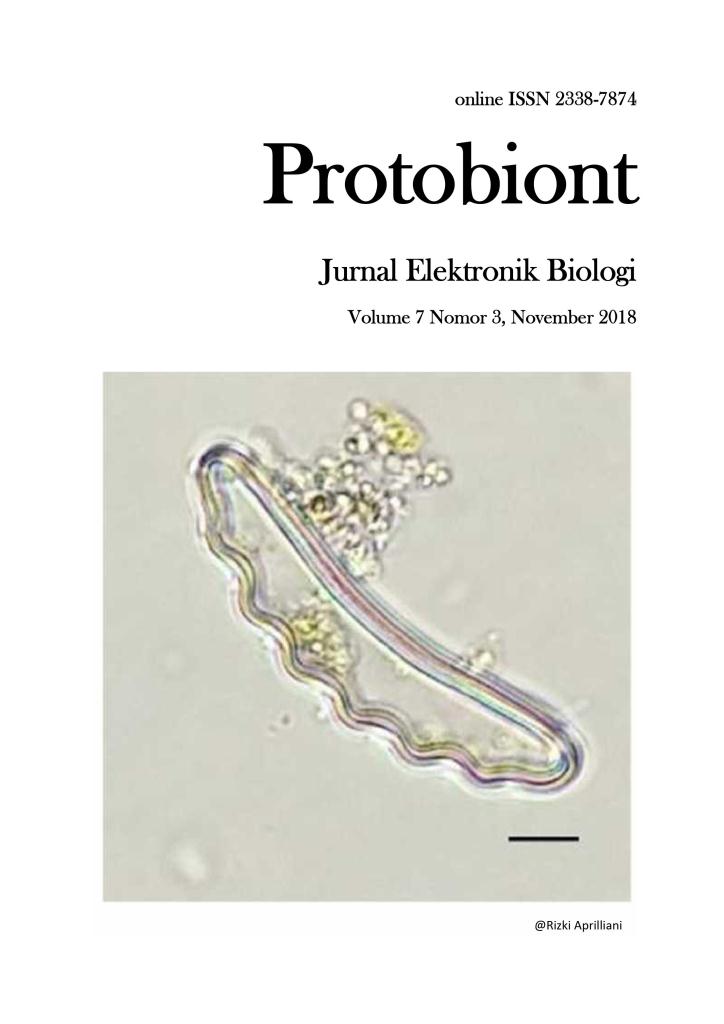
Downloads
Published
2018-11-27
Issue
Section
Articles
License
Authors who publish with this journal agree to the following terms:
- Authors retain copyright and grant the journal right of first publication with the work simultaneously licensed under a Creative Commons Attribution-ShareAlike License that allows others to share the work with an acknowledgement of the work's authorship and initial publication in this journal.
- Authors are not restricted by the journal from entering into separate, additional contractual arrangements for the non-exclusive distribution of the journal's published version of the work (e.g., posting it to an institutional repository or publishing it in a book), with an acknowledgement of its initial publication in this journal.
- Authors are permitted and encouraged to post their work online (e.g., in institutional repositories or on their website) after its publication in this journal. This approach aims to safeguard against potential plagiarism or unauthorized use of unpublished manuscripts, as outlined in the submission guidelines which state that this journal does not accept previously published manuscripts.
