
Inventarisasi Jenis-jenis Ular ( Serpenthes ) di Kawasan Universitas Tanjungpura Pontianak
DOI:
https://doi.org/10.26418/protobiont.v8i2.32480Keywords:
Inventory, Serpenthes, SnakeAbstract
Snakes is a Reptilian that important role in the food chains. This research was conducted in the area of Tanjungpura University, Pontianak. The aim of this research use to determine the types of snakes found and to find out the characteristics of each snake types in Tanjungpura University area Pontianak. The sampling research was done from March to May 2018, with the Visual Encounter Survey (VES) method. The results found 17 individual of 10 species, 7 families (Colubridae, Cylindrophiidae, Elapidae, Homalopsidae, Pythonidae, Typhlopidae, and Xenopeltidae). The snakes found consisted of 7 species of non- venomous snakes which included as Coelognathus flavolineatus, Cylindrophis ruffus, Homalopsis bucatta, Malayophiton reticulatus, Ptyas korros, Ramphotyphlops braminus (free-living snakes), Xenopeltis unicolor, and 3 species of poisonous snakes which included as Ahaetulla prasina, Dendrelaphis pictus, and Naja sputatrix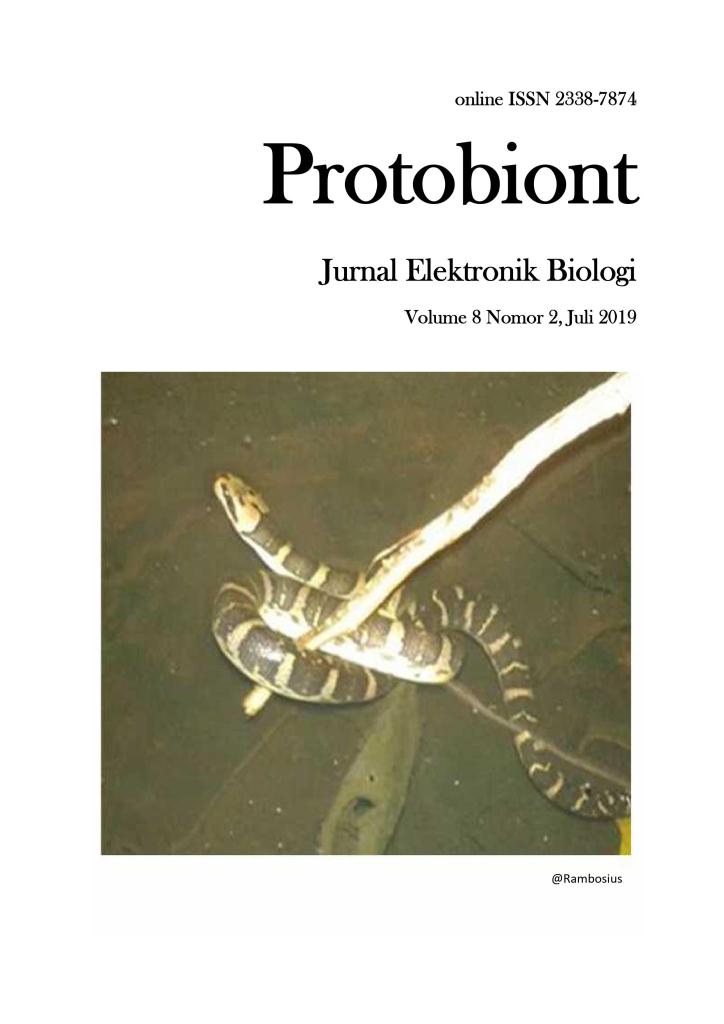
Downloads
Published
2019-03-24
Issue
Section
Articles
License
Authors who publish with this journal agree to the following terms:
- Authors retain copyright and grant the journal right of first publication with the work simultaneously licensed under a Creative Commons Attribution-ShareAlike License that allows others to share the work with an acknowledgement of the work's authorship and initial publication in this journal.
- Authors are not restricted by the journal from entering into separate, additional contractual arrangements for the non-exclusive distribution of the journal's published version of the work (e.g., posting it to an institutional repository or publishing it in a book), with an acknowledgement of its initial publication in this journal.
- Authors are permitted and encouraged to post their work online (e.g., in institutional repositories or on their website) after its publication in this journal. This approach aims to safeguard against potential plagiarism or unauthorized use of unpublished manuscripts, as outlined in the submission guidelines which state that this journal does not accept previously published manuscripts.
