
Tingkat Keberhasilan Penetasan Telur Penyu Hijau (Chelonia Mydas, Linnaeus 1758) di Pantai Sebubus, Kabupaten Sambas
DOI:
https://doi.org/10.26418/protobiont.v3i1.4581Keywords:
Green Turtle, hatchability, egg laying coast, nestAbstract
A succeed hatchery of green turtle’s eggs is determined by the condition of the environment and the position of the nests. The purposes of this research are to find out the succeed hatchery level of green turtle and the environmental condition of the nest in Sebubus coastal area. The sample of the nest was randomly selected and taken based on the existing nest proportion. There were three parameters, namely hatchability, physical characters of the coast and environmental conditions surrounding the nest. There were 24 nests in Sungai Belacan coast, 21 in Munggu Resak and three nests in Tanjung Kemuning. The number of eggs range between 85 – 102 eggs per nest. The percentage of green turtle’s hatchery in Sebubus coast were varied from 87.69% - 93.13%. 75% of the nests were found under pandanus tree. The shaded nests showed a higher hatchery percentage of 86.64% - 95.6%. The slope of Sebubus coast was ranged from 40 – 4.820. Temperature of nest incubation was varied from 28.180C to 28.370C. Green turtles dominantly made their nest in sandy substrate. The pH level of the observed nests was categorized as not too acidic ranging from 5.74 to 6.16. The overall environmental condition in Sebubus coastal area supports the hatchery of green turtle’s eggs.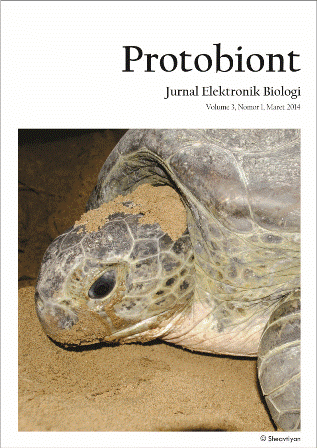
Downloads
Published
2014-02-16
Issue
Section
Articles
License
Authors who publish with this journal agree to the following terms:
- Authors retain copyright and grant the journal right of first publication with the work simultaneously licensed under a Creative Commons Attribution-ShareAlike License that allows others to share the work with an acknowledgement of the work's authorship and initial publication in this journal.
- Authors are not restricted by the journal from entering into separate, additional contractual arrangements for the non-exclusive distribution of the journal's published version of the work (e.g., posting it to an institutional repository or publishing it in a book), with an acknowledgement of its initial publication in this journal.
- Authors are permitted and encouraged to post their work online (e.g., in institutional repositories or on their website) after its publication in this journal. This approach aims to safeguard against potential plagiarism or unauthorized use of unpublished manuscripts, as outlined in the submission guidelines which state that this journal does not accept previously published manuscripts.
