
Pertumbuhan stek batang kantong semar (Nepenthes bicalcarata Hooker) dengan penambahan Indole Butyric Acid (IBA)
DOI:
https://doi.org/10.26418/protobiont.v3i3.7115Keywords:
Stem cuttings, Nepenthes bicalcarata, IBAAbstract
Nepenthes bicalcarata commonly grows in the edge of swampy mangrove forest and heath forest which are poor in nutrients and have a relatively high humidity. The conservation effort on N. bicalcarata can be done through plant multiplication by stem cuttings. This study aims to determine the effect of indole butyric acid (IBA) growth regulator addition on the growth of N. bicalcarata stem cuttings and to determine the concentration of IBA growth regulator that can give the best growth on N. Bicalcarata stem cuttings. The study was conducted in November 2013 to February 2014. Based on ANOVA analysis, the addition of IBA on N. bicalcarata stem cuttings significantly affected the height of the plant and the number of roots. The best IBA concentration given on N. bicalcarata stem cuttings was at 15 ppm, resulting in 19,50 cm of average plant heights and 27,25 of average roots number. The addition of IBA did not significantly affect the number of leaves and initial budding period.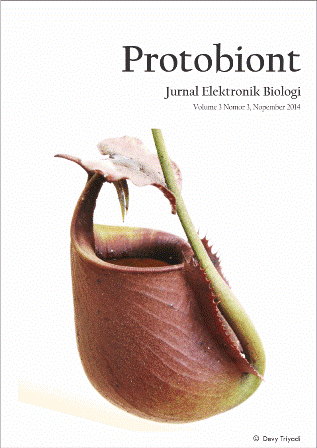
Downloads
Published
2014-09-22
Issue
Section
Articles
License
Authors who publish with this journal agree to the following terms:
- Authors retain copyright and grant the journal right of first publication with the work simultaneously licensed under a Creative Commons Attribution-ShareAlike License that allows others to share the work with an acknowledgement of the work's authorship and initial publication in this journal.
- Authors are not restricted by the journal from entering into separate, additional contractual arrangements for the non-exclusive distribution of the journal's published version of the work (e.g., posting it to an institutional repository or publishing it in a book), with an acknowledgement of its initial publication in this journal.
- Authors are permitted and encouraged to post their work online (e.g., in institutional repositories or on their website) after its publication in this journal. This approach aims to safeguard against potential plagiarism or unauthorized use of unpublished manuscripts, as outlined in the submission guidelines which state that this journal does not accept previously published manuscripts.
