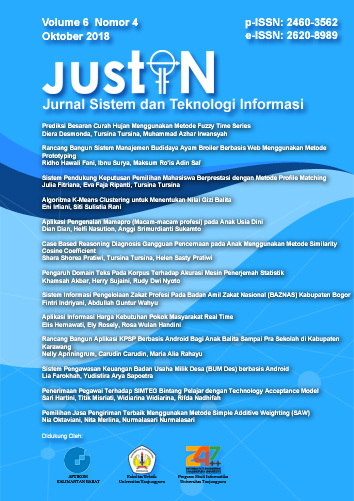
Prediksi Besaran Curah Hujan Menggunakan Metode Fuzzy Time Series
DOI:
https://doi.org/10.26418/justin.v6i4.27036Keywords:
Curah Hujan, Forecasting, Fuzzy Time Series, Logika Fuzzy, Time SeriesAbstract
Iklim tropis yang memiliki dua musim, yakni musim penghujan dan musim kemarau yang seharusnya berputar setiap enam bulan sekali. Namun beberapa tahun terakhir ini, perubahan iklim global terasa ditandai dengan tidak menentunya perputaran musim kemarau maupun musim penghujan. Untuk mengetahui perubahan pola curah hujan tersebut, maka dirancanglah prediksi besaran curah hujan untuk melihat dan menganalisa pola hujan yang akan terbentuk ke depannya. Aplikasi prediksi besaran curah hujan yang akan dibangun menggunakan forecasting atau peramalan dengan metode Fuzzy Time Series. Logika fuzzy digunakan karena dapat memetakan suatu input ke dalam suatu output dan memiliki toleransi terhadap data-data yang tersedia. Adapun hasil dari penelitian yang dilakukan adalah mengimplementasikan metode Fuzzy Time Series untuk membangun aplikasi yang dapat mengolah dan menghitung pola data curah hujan serta memprediksi besaran curah hujan. Hasil dari pengujian diperoleh nilai MAPE (Mean Average Percentage Error) bervariasi tergantung jumlah data dan jumlah interval yang digunakan. Nilai MAPE terbaik yang diperoleh adalah 0,151% pada penggunaan data curah hujan periode 2015 "“ 2017 dengan jumlah interval 401. Perhitungan menggunakan metode Fuzzy Time Series sangat dipengaruhi oleh jumlah data yang digunakan dan jumlah interval dalam membagi data tersebut.References
Huang, K. 2001. Heuristic Models of Fuzzy Time Series for Forecasting. Journal of Fuzzy Sets and Systems.
Synaptic. 2005. Fuzzy Math, Part I, The Theory. http://www/scholarpedia.org/article/Fuzzy_logic.
Daldjoeni, N. 1986. Pokok-pokok Klimatologi. Bandung : Alumni.
Mandey, F. N. 2017. Pemodelan Sistem Prediksi Intensitas Curah Hujan Kota Manado dengan Menggunakan Kontrol Logika Fuzzy. Jurnal MIPA UNSRAT.
Buffa, E.S. & Sarin, R.K. 2007. Modern Production / Operation Management, 8th Ed. United States : John Wiley and Sons, Inc.
Brata, A. S. 2016. Penerapan Fuzzy Time Series dalam Peramalan Data Seasonal. Malang : Universitas Islam Negeri Maulana Malik Ibrahim.
Hisyam, M., Lee & Suharto. 2012. A Weighted Fuzzy Time Series Model for Forecasting Seasonal Data.
Saleh, M. N. 2017. Implementasi Peramalan Menggunakan Fuzzy Time Series pada Aplikasi Helpdesk Inventaris Perangkat Teknologi Informasi. Jurnal Sistem dan Teknologi Informasi (JUSTIN) Vol.1, No.2
Makridakis, S., Steven, C., Wheelwright, V.E., & McGee. 1999. Metode dan Aplikasi Peramalan Jilid 2. Jakarta : Binarupa Aksara.
Soewarno. 2015. Klimatologi, Pengukuran dan Pengolahan Data Curah Hujan, Contoh Aplikasi Hidrologi dalam Pengelolaan Sumber Daya Air. Yogyakarta : Graha Ilmu.
Triadmojo, Bambang. 2008. Hidrologi Terapan. Yogyakarta : Beta Offset.
Heizer, J. & Render, B. 2005. Operation Management, 7th Edition. Jakarta : Penerbit Salemba Empat.
Halimi, Imam. 2018. Prediksi Indeks Harga Saham Gabungan (IHSG) Menggunakan Algoritma Neural Network. Jurnal Edukasi dan Penelitian Informatika (JEPIN) Vol.4, No.1.
Hwang, J.R., Chen, S.M & Lee, C.H. Handling Forecasting Problems using Fuzzy Time Series. Journal of Fuzzy Sets and Systems.
Kusumadewi, S. & Purnomo, H. 2004. Aplikasi Logika Fuzzy untuk Pendukung Keputusan. Yogyakarta : Graha Ilmu.
Kusumadewi, S. 2002. Analisis Desain Fuzzy Menggunakan Tool Box Matlab. Yogjakarta : Graha Ilmu.
Nikentari, N. 2018. Prediksi Kecepatan Angin Menggunakan Adaptive Neuro Fuzzy (ANFIS) dan Radical Basis Function Neural Network (RBFNN). Jurnal Edukasi dan Penelitian Informatika (JEPIN) Vol.4, No.1.
Chen, S.M. 1996. Forecasting Enrollments Based on Fuzzy Time Series. Journal of Fuzzy Sets and Systems.
Elfajar, A. B. 2017. Peramalan Jumlah Kunjungan Wisatawan Kota Batu Menggunakan Metode Time Invariant Fuzzy Time Series. Jurnal Pengembangan Teknologi Informasi dan Ilmu Komputer Vol.1, No.2.
Pakaja, F., Naba, A., Purwanto. (2012), Peramalan Penjualan Mobil Menggunakan Jaringan Syaraf Tiruan dan Certainty Factor, Jurnal EECCIS, Vol.6, No.1, Juni 2012.
Downloads
Published
Issue
Section
License
Copyright (c) 2018 JUSTIN (Jurnal Sistem dan Teknologi Informasi)

This work is licensed under a Creative Commons Attribution-NonCommercial-ShareAlike 4.0 International License.
The author owns the copyright in his paper and agrees to publish his paper to JUSTIN by giving the rights to the first publication of his paper which is simultaneously licensed under the Creative Commons Attribution License, namely the Similar International 4.0 license (CC BY-NC-SA 4.0).

This is a human-readable summary of (and not a substitute for) the license. Disclaimer.
You are free to:Share "” copy and redistribute the material in any medium or format
Adapt "” remix, transform, and build upon the material
The licensor cannot revoke these freedoms as long as you follow the license terms.
Under the following terms:
Attribution "” You must give appropriate credit, provide a link to the license, and indicate if changes were made. You may do so in any reasonable manner, but not in any way that suggests the licensor endorses you or your use.
NonCommercial "” You may not use the material for commercial purposes.
ShareAlike "” If you remix, transform, or build upon the material, you must distribute your contributions under the same license as the original.
No additional restrictions "” You may not apply legal terms or technological measures that legally restrict others from doing anything the license permits.
Notices:
You do not have to comply with the license for elements of the material in the public domain or where your use is permitted by an applicable exception or limitation.
No warranties are given. The license may not give you all of the permissions necessary for your intended use. For example, other rights such as publicity, privacy, or moral rights may limit how you use the material.
