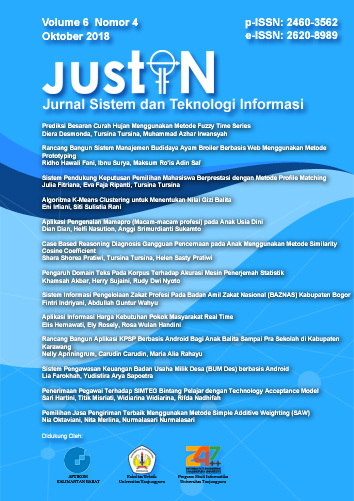
Penerimaan Pegawai Terhadap SIMTEG Bintang Pelajar dengan Technology Acceptance Model
DOI:
https://doi.org/10.26418/justin.v6i4.29201Keywords:
Sistem Informasi, Bintang Pelajar, Technology Acceptance ModelAbstract
SIMTEG (Sistem Informasi Manajemen Terintegrasi) yang dikembangkan oleh Bimbel Bintang Pelajar diharapkan dapat meningkatkan kinerja bagi pegawai. Sejauh ini, masih terdapat beberapa kendala yang dihadapi pegawai sebagai user dalam penggunaan SIMTEG. Oleh karena itu, untuk mengetahui penerimaan pegawai terhadap keberhasilan pengimplementasian SIMTEG, maka perlu dilakukan evaluasi dengan menggunakan metode Technology Acceptance Model. Data yang didapat dari 30 responden dengan skala likert, diperoleh hasil yang menunjukkan terdapat pengaruh signifikan antara kemudahan penggunaan dan kemanfaatan terhadap penerimaan SIMTEG Bintang Pelajar. Dengan nilai korelasi sebesar 0,779 hasil penelitian menunjukkan bahwa kemudahan penggunaan dan kemanfaatan berpengaruh 59,3% kepada penerimaan pegawai terhadap SIMTEG.References
R. Oktofiyani, Nurmalasari, and W. Anggraeni, “Penerimaan Sistem E-Learning Menggunakan Technology Acceptance Model (TAM) Study Kasus Siswa/i Kelas X Di SMU Negeri 92 Jakarta,†J. Pilar Nusa Mandiri, vol. 12, no. 1, pp. 46–53, 2016.
J. S. P. Tyoso, Sistem Informasi Manajemen. Yogyakarta: Deepublish, 2016.
J. Hutatean, Konsep Sistem Informasi. Yogyakarta: Deepublish, 2014.
J. L. Gaol, Sistem Informasi Manajemen Pemahaman dan Aplikasi. Jakarta: Grasindo, 2008.
J. H. Mustakini, “Sistem Informasi Keperilakuan,†Yogyakarta: Andi, 2007.
Sugiyono, Metode penelitian pendidikan:(pendekatan kuantitatif, kualitatif dan R & D). Bandung: Alfabeta, 2008.
Downloads
Published
Issue
Section
License
Copyright (c) 2018 JUSTIN (Jurnal Sistem dan Teknologi Informasi)

This work is licensed under a Creative Commons Attribution-NonCommercial-ShareAlike 4.0 International License.
The author owns the copyright in his paper and agrees to publish his paper to JUSTIN by giving the rights to the first publication of his paper which is simultaneously licensed under the Creative Commons Attribution License, namely the Similar International 4.0 license (CC BY-NC-SA 4.0).

This is a human-readable summary of (and not a substitute for) the license. Disclaimer.
You are free to:Share "” copy and redistribute the material in any medium or format
Adapt "” remix, transform, and build upon the material
The licensor cannot revoke these freedoms as long as you follow the license terms.
Under the following terms:
Attribution "” You must give appropriate credit, provide a link to the license, and indicate if changes were made. You may do so in any reasonable manner, but not in any way that suggests the licensor endorses you or your use.
NonCommercial "” You may not use the material for commercial purposes.
ShareAlike "” If you remix, transform, or build upon the material, you must distribute your contributions under the same license as the original.
No additional restrictions "” You may not apply legal terms or technological measures that legally restrict others from doing anything the license permits.
Notices:
You do not have to comply with the license for elements of the material in the public domain or where your use is permitted by an applicable exception or limitation.
No warranties are given. The license may not give you all of the permissions necessary for your intended use. For example, other rights such as publicity, privacy, or moral rights may limit how you use the material.
