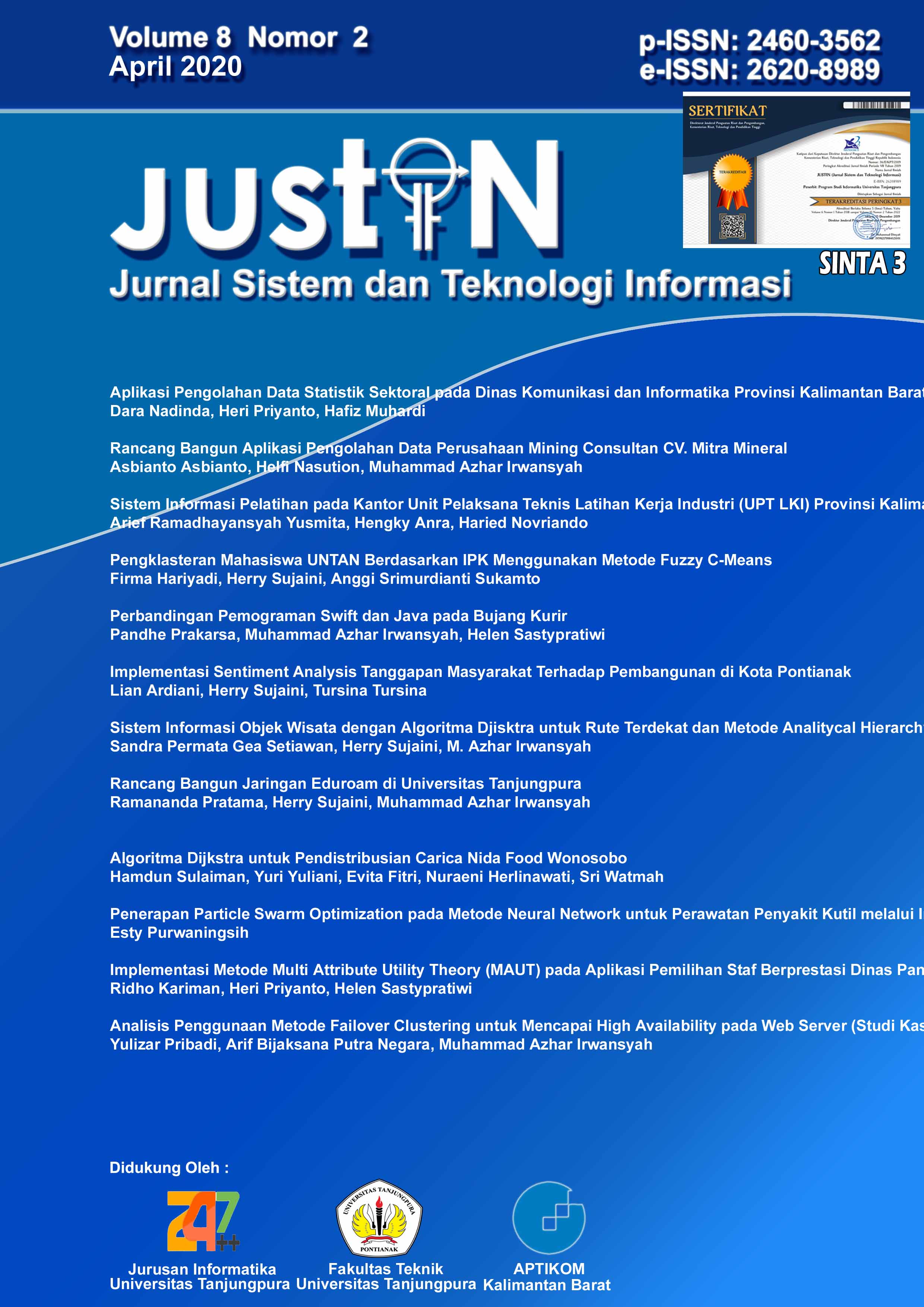
Penerapan Particle Swarm Optimization pada Metode Neural Network untuk Perawatan Penyakit Kutil melalui Immunotherapy
DOI:
https://doi.org/10.26418/justin.v8i2.39869Keywords:
data mining, neural network, pso, immunotherapyAbstract
Human papillomaviruses (HPVs) merupakan virus yang menimbulkan infeksi pada permukaan kulit dan dapt menyebabkan tumor sampai dengan kanker, salh satu penyakit yang disebabkan oleh HPVs adalah kutil. Immunotheraphy dapat dimanfaatkan untuk mengobati penyakit kutil. Sehingga penelitian ini melakukan penerapan metode neural network dengan algoritma PSO yang bertujuan untuk mengetahui nilai akurasi dari metode neural network dengan algoritma PSO yang berperan membantu menganalisis apakah peran immunotherapy lebih efektif dalam penyembuhan penyakit kutil dan kanker kulit. Setelah dilakukan pengujian melalui aplikasi rapid miner diketahui bahwa model Neural Network (NN) dengan algoritma PSO memiliki nilai akurasi sebesar 87.78%. Hasil perhitungan, performance keakurasian AUC yang diperoleh masuk kedalam kategori Good Classification dengan nilai AUC sebesar 0,757 dan memiliki nilai RMSE 0.331. Dengan demikian, metode Neural Network dengan algoritma PSO dapat digunakan untuk perawatan penyakit kutil melalui immunotherapy.References
M. M. Ghiasi and S. Zendehboudi, “Decision tree-based methodology to select a proper approach for wart treatment,†Comput. Biol. Med., vol. 108, no. February, pp. 400–409, 2019.
F. Khozeimeh et al., “Intralesional immunotherapy compared to cryotherapy in the treatment of warts,†Int. J. Dermatol., vol. 56, no. 4, pp. 474–478, 2017.
W. Jia, H. Xia, L. Jia, Y. Deng, and X. Liu, “The selection of wart treatment method based on Synthetic Minority Over-sampling Technique and Axiomatic Fuzzy Set theory,†Biocybern. Biomed. Eng., pp. 1–10, 2020.
I. Medikal, E. Üniversitesi, and E. Binası, “Naive Bayes ve En Yakın k Kom ¸ su Sınıflandırıcıları ile Si ˘ gil Tedavi Yöntemi Seçimi Choose of Wart Treatment Method Using Naive Bayes and k-Nearest Neighbors Classifiers,†pp. 0–3, 2018.
M. Abdar et al., IAPSO-AIRS: A novel improved machine learning-based system for wart disease treatment, vol. 43, no. 7. 2019.
A. Junio Guimarães, P. Vitor de Campos Souza, V. Jonathan Silva Araújo, T. Silva Rezende, and V. Souza Araújo, “Pruning Fuzzy Neural Network Applied to the Construction of Expert Systems to Aid in the Diagnosis of the Treatment of Cryotherapy and Immunotherapy,†Big Data Cogn. Comput., vol. 3, no. 2, p. 22, 2019.
S. B. Akben, “Predicting the success of wart treatment methods using decision tree based fuzzy informative images,†Biocybern. Biomed. Eng., vol. 38, no. 4, pp. 819–827, 2018.
A. Supriyatna and W. P. Mustika, “Komparasi Algoritma Naive bayes dan SVM Untuk Memprediksi Keberhasilan Imunoterapi Pada Penyakit Kutil,†J-SAKTI (Jurnal Sains Komput. dan Inform., vol. 2, no. 2, p. 152, 2018.
B. Santosa, Data Mining: Teknik Pemanfaatan Data Untuk Keperluan Bisnis. Yogyakarta: Graha Ilmu, 2007.
M. A. Witten, I. H., Frank, E., & Hall, Data Mining : Practical Machine Learning and Tools. Burlington: Morgan Kaufmann Publisher, 2011.
A. E, Pengantar Jaringan Saraf Tiruan. Wonosobo: Star Publishing, 2009.
K. A, Shukla; R, Tiwari;R, Real Life Application of Soft Computing. CRC Press, 2010.
H. Muhamad, C. A. Prasojo, N. A. Sugianto, L. Surtiningsih, and I. Cholissodin, “Optimasi Naïve Bayes Classifier Dengan Menggunakan Particle Swarm Optimization Pada Data Iris,†J. Teknol. Inf. dan Ilmu Komput., vol. 4, no. 3, p. 180, 2017.
B. Xue, M. Zhang, S. Member, and W. N. Browne, “Particle Swarm Optimization for Feature Selection in Classification : A Multi-Objective Approach,†Ieee Trans. Cybern., pp. 1–16, 2012.
Ridwansyah, I. Ariyati, and S. Faizah, “Particle Swarm Optimization Berbasis Co-Evolusioner,†J. SAINTEKOM, vol. 9, no. 2, pp. 166–177, 2012.
F. Gorunescu, Data Mining Concepts, Models and Techniques. Berlin Heidelberg: Springer Verlag, 2011.
S. S, Metode Peramalan Bisnis Masa Kini dengan Minitab dan SPSS. Jakarta: PT Elex Media Komputindo, 2009.
Downloads
Published
Issue
Section
License
Copyright (c) 2020 Jurnal Sistem dan Teknologi Informasi (JUSTIN)

This work is licensed under a Creative Commons Attribution-NonCommercial-ShareAlike 4.0 International License.
The author owns the copyright in his paper and agrees to publish his paper to JUSTIN by giving the rights to the first publication of his paper which is simultaneously licensed under the Creative Commons Attribution License, namely the Similar International 4.0 license (CC BY-NC-SA 4.0).

This is a human-readable summary of (and not a substitute for) the license. Disclaimer.
You are free to:Share "” copy and redistribute the material in any medium or format
Adapt "” remix, transform, and build upon the material
The licensor cannot revoke these freedoms as long as you follow the license terms.
Under the following terms:
Attribution "” You must give appropriate credit, provide a link to the license, and indicate if changes were made. You may do so in any reasonable manner, but not in any way that suggests the licensor endorses you or your use.
NonCommercial "” You may not use the material for commercial purposes.
ShareAlike "” If you remix, transform, or build upon the material, you must distribute your contributions under the same license as the original.
No additional restrictions "” You may not apply legal terms or technological measures that legally restrict others from doing anything the license permits.
Notices:
You do not have to comply with the license for elements of the material in the public domain or where your use is permitted by an applicable exception or limitation.
No warranties are given. The license may not give you all of the permissions necessary for your intended use. For example, other rights such as publicity, privacy, or moral rights may limit how you use the material.
