
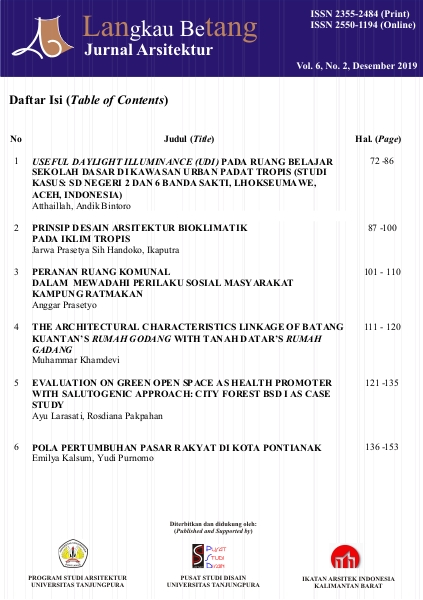
POLA PERTUMBUHAN PASAR RAKYAT DI KOTA PONTIANAK
DOI:
https://doi.org/10.26418/lantang.v6i2.33223Keywords:
Pasar rakyat, pola, pertumbuhanAbstract
Pasar tradisional atau pasar rakyat merupakan sebuah pusat kegiatan ekonomi di suatu daerah yang juga menjadi perwujudan kesejahteraan masyarakat sangat berpotensi dalam menggerakkan roda perekonomian berbasis ekonomi rakyat. Pasar rakyat mampu bertahan memberikan pelayanan kebutuhan kepada masyarakat luas sekalipun dalam kondisi krisis perekonomian. Pasar rakyat telah menggambarkan denyut nadi perekonomian rakyat. Oleh karena itu, sangatlah penting untuk menyelamatkan keberadaan pasar rakyat yang kini semakin terhimpit oleh adanya pasar modern yang terus meningkat saat ini. Pemerintah telah memiliki berbagai kebijakan untuk mengantisipasi masalah ini di antaranya adalah Peraturan Presiden Nomor 112 tahun 2007 tentang Penataan dan Pembinaan Pasar rakyat, Pusat Perbelanjaan dan Toko Modern. Namun berbagai kebijakan seringkali hanya diberlakukan pada pasar rakyat yang disediakan atau dibangun oleh pemerintah atau pengelola wilayah. Padahal tak jarang, pasar rakyat yang ada berawal dari pasar yang tumbuh dari swadaya masyarakat. Pasar seperti ini hampir merata tumbuh di setiap kota di Indonesia demikian pula di Kota Pontianak. Identifikasi pola pertumbuhan pasar rakyat di Kota Pontianak ini dimaksudkan untuk mengetahui bagaimana sebetulnya sebuah pasar rakyat tumbuh dan berkembang di area permukiman. Penelitian ini menggunakan metode deskriptif dengan pendekatan kuantitatif, dalam upaya mendeskripsikan gejala atau fenomena tentang pertumbuhan yang terjadi pada saat penelitian dilakukan. Pendekatan kuantitatif dilakukan dalam rangka untuk mengetahui jumlah pasar rakyat hasil swadaya masyarakat. Pola pertumbuhan pasar rakyat di Kota Pontianak yang terbentuk dari swadaya masyarakat Kota Pontianak yang ditunjukkan dari hasil penelitian ini sangat relevan untuk menjadi pertimbangan dalam penataan pasar rakyat di Kota Pontianak di masa yang akan datang. Ini terkait pada kebutuhan masyarakat, lokasi, kepemilikan, penempatan dan pengelolaan.
PUBLIC MARKETS GROWTH PATTERN IN PONTIANAK
Traditional markets or public markets are the centers of economic activity in an area that also embody the welfare of the people who have great potential and can drive the economy of the people. During financial crisis, the markets can survive, providing service needs to the community. Public markets have described the pulse of the people's economy. Therefore, the existence of public markets, which are now increasingly squeezed by the rapid growth of the modern stores, are important to be immediately saved. The government already has several legal protections to overcome this problem, one of it is the Presidential Regulation Number 112 of 2007 concerning the Arrangement and Development of Public Markets, Shopping Centers and Modern Stores. However, various policies are often only applied to the public markets that are provided or built by the government or regional managers. Even though it is not uncommon that the existing public markets originated from markets that grow from nongovernmental community self-help. These markets are almost evenly grown in every city in Indonesia, as well as in Pontianak. Identification of the pattern of growth of the public markets in Pontianak is intended to find out how public markets grow and develop in residential areas. This research uses a descriptive method with a quantitative approach, to describe the symptoms or phenomena about the growth that occur at the time the research is conducted. A quantitative approach is carried out to find out the number of people's markets resulting from nongovernmental community self-help. The results showed that the pattern of growth of public market in Pontianak which was formed from the self-help of the people was very relevant to be considered in the structuring of the public markets in Pontianak in the future. This is related to community needs, location, ownership, placement, and management.
References
Appel, D., (1972). The supermarket: early development of an institutional innovation. Journal of Retailing 48 (Spring), 39–52.
Cook, I. (2008). Geographies of food: mixing, Progress in Human Geography 32(6): 821–833.
Findlay, A., Paddison, R., Dawson, J. (Eds.), (1990), Retailing Environments in Developing Countries. Routledge, London.
Goldman, A., (1981). Transfer of a retailing technology into less developed countries: the supermarket case. Journal of Retailing 57 (2), 5–29.
Goldman, A., and Hayiel Hino, (2005). Supermarkets vs. traditional retail stores: diagnosing the barriers to supermarkets’ market share growth in an ethnic minority community. Journal of Retailing and Consumer Services. pp. 273–284.
Gonzalez, S and Waley, P. (2013). Traditional Retail Markets: The New Gentrification Frontier? Antipode: a radical journal of geography, 45 (4). 965 - 983. ISSN 0066-4812.
Heldke, L. (2003). Exotic Appetites: Ruminations of a Food Adventurer. London: Routledge.
Hendrakusumah, E. (2014). Penanganan Permukiman Kumuh Berbasis Kawasan Bernilai Tambah dan Berkelanjutan. Seminar Nasional. UNISBA.
Kaynak, E., Cavusgil, T., (1982). The evolution of food retailing systems: contrasting the experience of developed and developing Countries. Journal of the Academy of Marketing 10 (3), 249–269.
Kementerian Perdagangan, BPPKP, Pusat Kebijakan Perdagangan Dalam Negeri. (2012). Peran Revitalisasi Terhadap Kinerja Pasar Tradisional.
Kumcu, E., Kumcu, M., (1987). Determinants of food retailing in developing countries: the case of Turkey. Journal of Macromarketing 7 (fall), 26–40.
Lagerkvist, et al. (2015). Consumers' evaluation of volition, control, anticipated regret, and perceived food health risk. Evidence from a field experiment in a traditional vegetable market in Kenya. Food Control 47, pp. 359-368.
Lupitosari, D. (2011). Dampak Jumlah Pasar dan Jumlah Pedagang Terhadap Pertumbuhan Ekonomi Kota Surakarta Sebelum Dan Sesudah Kebijakan Revitalisasi Pasar Tradisional. Skripsi. Surakarta - F. Ekonomi.
Peraturan Menteri Perdagangan Republik Indonesia No. 48 Tahun 2013 tentang Pedoman Pembangunan dan Pengelolaan Sarana Distribusi Perdagangan
Peraturan Menteri Perdagangan Republik Indonesia No. 70 Tahun 2013 tentang Pedoman Penataan dan Pembinaan Pasar Tradisional, Pusat Perbelanjaan dan Toko Modern
Peraturan Menteri Perdagangan Republik Indonesia No. 53 Tahun 2008 tentang Pedoman Penataan dan Pembinaan Pasar Rakyat, Pusat Perbelanjaan dan Toko Modern
Peraturan Presiden Republik Indonesia No. 112 Tahun 2007 tentang Penataan dan Pembinaan Pasar Tradisional, Pusat Perbelanjaan dan Toko Modern
Schipmann, C., & Matin Qaim. (2011). Supply Chain Differentiation, Contract Agriculture, and Farmers’ Marketing Preference: The Case of Sweet Pepper in Thailand. Globalfood Discussion Papers.
Slater, C. and Henley, D. (1969). Market processes in La Paz, Bolivia, Latin American Studies Center. Michigan State University, East Lansing.
Suryadarma, et al. (2009). Dampak Supermarket terhadap Pasar dan Pedagang Ritel Tradisional di Daerah Perkotaan di Indonesia. SMERU.
Downloads
Published
Issue
Section
License
Copyright (c) 2019 LANGKAU BETANG: JURNAL ARSITEKTUR

This work is licensed under a Creative Commons Attribution-NonCommercial 4.0 International License.
Copyright Holder: Langkau Betang: Jurnal Arsitektur, By submitting the manuscript, Authors willing to delivered the copyright to the publisher. Authors are free to use their published manuscript as a reference in their later works

This work is licensed under a Creative Commons Attribution 4.0 International License.
You are free to:
- Share "” copy and redistribute the material in any medium or format
- Adapt "” remix, transform, and build upon the material
- for any purpose, even commercially.
- Attribution "” You must give appropriate credit, provide a link to the license, and indicate if changes were made. You may do so in any reasonable manner, but not in any way that suggests the licensor endorses you or your use.
- No additional restrictions "” You may not apply legal terms or technological measures that legally restrict others from doing anything the license permits.
- You do not have to comply with the license for elements of the material in the public domain or where your use is permitted by an applicable exception or limitation.
- No warranties are given. The license may not give you all of the permissions necessary for your intended use. For example, other rights such as publicity, privacy, or moral rights may limit how you use the material.
