
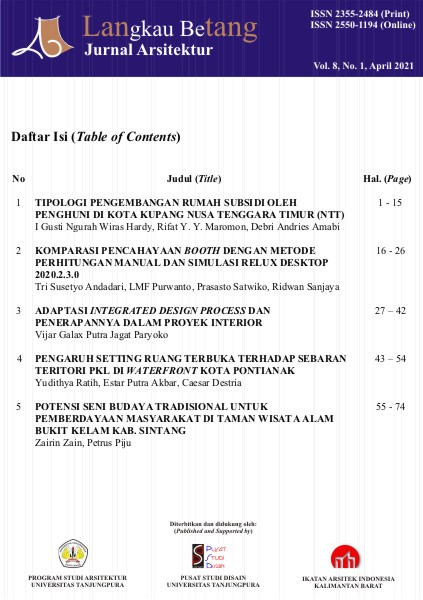
ADAPTASI INTEGRATED DESIGN PROCESS DAN PENERAPANNYA DALAM PROYEK INTERIOR
DOI:
https://doi.org/10.26418/lantang.v8i1.43486Keywords:
Integrated Design Proses, IDP, InteriorAbstract
Lingkup pembangunan berkelanjutan (sustainable development) mencakup segala bidang perancangan, termasuk desain perkotaan, arsitektur, hingga interior. Tingginya lahan dan minat terhadap usaha bidang interior di perkotaan menjadi salah satu latar belakang perlunya meningkatkan pertimbangan isu berkelanjutan dalam bidang tersebut. Integrated Design Process (IDP) berpotensi diadaptasi untuk proyek interior karena kompatibel dengan sistem design-build yang banyak diminati untuk menyelesaikan proyek interior. Studi ini bertujuan untuk menemukan gambaran adaptasi IDP pada bidang interior, serta potensi dan kendala penerapannya pada proyek nyata. Strategi studi kasus digunakan untuk mencapai tujuan tersebut, penekanan studi pada kajian literatur dan proyek nyata sebuah pekerjaan interior menggunakan teknik observasi dan arsip. Disimpulkan bahwa estimasi anggaran dan pengelolaan keuangan proyek lebih efektif, mengurangi resiko kendala konstruksi, manfaat jangka panjang produk, serta meningkatkan keharmonisan hubungan antara perusahaan dan pemilik proyek, merupakan keuntungan yang diperoleh. Kendala yang ditemui adalah kenaikan biaya proyek yang dapat ditekan dengan efisiensi material dan akomodasi, serta kebutuhan lebih atas waktu dan usaha untuk mencapai mufakat pada tahap perancangan yang dapat ditekan melalui peran perancang. Hasil studi ini diharapkan mampu meningkatkan kesadaran masyarakat akan kebutuhan perencanaan dan pengelolaan yang terintegrasi untuk menghasilkan produk yang mampu berkontribusi pada pembangunan berkelanjutan.
ADAPTATION OF INTEGRATED DESIGN PROCESS AND ITS IMPLEMENTATION FOR INTERIOR PROJECT
"Sustainable development" encompasses design fields as a whole, including urban, architecture, and interior design. Increasing demand and interest for interior business in cities is one reason for the need to increase sustainable development issues in this field. Integrated Design Process (IDP) potential to be adapted from building to interior projects is high because it is compatible with the design-build system commonly used for interior project completion. This study aims to find an overview of IDP adaptation for the interior field and the benefits and obstacles to a real project. A case study strategy is used in this study to achieve these aims, where the emphasis is on literature searching and real project analysis using observation and archive tactics. This study concludes that the benefits are practical project budgeting and financing, reducing construction risks, and long-term benefits of product. The obstacles are the increased project cost which can be pressed by efficiency of materials and accommodation, and the time and effort to reach consensus at the design phase, which designer"™s role in the project team can press. Results of this study are expected to increase public awareness of the need for integrated planning and management of interior production so it can contribute to "sustainable development".
References
Attia, S., Walter, E., & Andersen, M. (2013). Identifying and modeling the integrated design process of net Zero Energy buildings. Proceedings of the High Performance Buildings - Design and Evaluation Methodologies Conference. http://hdl.handle.net/2268/164039
BC Green Building Roundtable. (2007). Roadmap for The Integrated Design Process. BC Green Building Roundtable. http://www.greenspacencr.org/
Boche, A. (2020). Application of the Integrated Design Process (IDP) Method to the Design of Riverside on the Example of Zmigr ó d. Sustainability, 12(2020), 1–18. https://doi.org/https://doi.org/10.3390/su12166684
Groat, L. N., & Wang, D. (2013). Architectural Research Methods (Second). John Wiley & Sons.
Haddad, R. (2014). Research and Methodology for Interior Designers. Procedia - Social and Behavioral Sciences, 122, 283–291. https://doi.org/10.1016/j.sbspro.2014.01.1343
Kanters, J., & Horvat, M. (2012). The design process known as IDP: A discussion. Energy Procedia, 30, 1153–1162. https://doi.org/10.1016/j.egypro.2012.11.128
Kim, J.-J., & Rigdon, B. (1998). Introduction to Sustainable Design. National Pollution Prevention Center for Higher Education.
Koch, C., & Buhl, H. (2013). Integrated Design Process; a Concept for Green Energy Engineering. Engineering, 05(03), 292–298. https://doi.org/10.4236/eng.2013.53039
Paryoko, V. G. P. J. (2019). Efektifitas Metode Eksplorasi Konsep dalam Studio Perancangan Arsitektur Tematik Bagi Mahasiswa Studi Kasus: Universitas Merdeka Surabaya . Arsitektura, 17, 249–260. https://doi.org/10.20961/arst.v17i2.33154
Rachmayanti, S., & Roesli, C. (2014). Green Design dalam Desain Interior dan Arsitektur. Humaniora, 5(2), 930. https://doi.org/10.21512/humaniora.v5i2.3191
Toofan, S. (2014). Importance of Humane Design for Sustainable Landscape. International Journal of Engineering and Technology, 6(6), 508–511. https://doi.org/10.7763/ijet.2014.v6.750
Wijayanto. (2019, August 22). Perkembangan Properti Dorong Kinerja Desain Interior. Radar Surabaya. https://radarsurabaya.jawapos.com/read/2019/08/22/152051/perkembangan-properti-dorong-kinerja-desain-interior
Zabihi, H., Habib, F., & Mirsaeedie, L. (2012). Sustainability in Building and Construction : Revising Definitions and Concepts. International Journal of Emerging Sciences, 2(December), 570–578. http://ijes.info/2/4/42542406.pdf
Downloads
Additional Files
Published
Issue
Section
License
Copyright (c) 2021 LANGKAU BETANG: JURNAL ARSITEKTUR

This work is licensed under a Creative Commons Attribution-NonCommercial-ShareAlike 4.0 International License.
Copyright Holder: Langkau Betang: Jurnal Arsitektur, By submitting the manuscript, Authors willing to delivered the copyright to the publisher. Authors are free to use their published manuscript as a reference in their later works

This work is licensed under a Creative Commons Attribution 4.0 International License.
You are free to:
- Share "” copy and redistribute the material in any medium or format
- Adapt "” remix, transform, and build upon the material
- for any purpose, even commercially.
- Attribution "” You must give appropriate credit, provide a link to the license, and indicate if changes were made. You may do so in any reasonable manner, but not in any way that suggests the licensor endorses you or your use.
- No additional restrictions "” You may not apply legal terms or technological measures that legally restrict others from doing anything the license permits.
- You do not have to comply with the license for elements of the material in the public domain or where your use is permitted by an applicable exception or limitation.
- No warranties are given. The license may not give you all of the permissions necessary for your intended use. For example, other rights such as publicity, privacy, or moral rights may limit how you use the material.
