
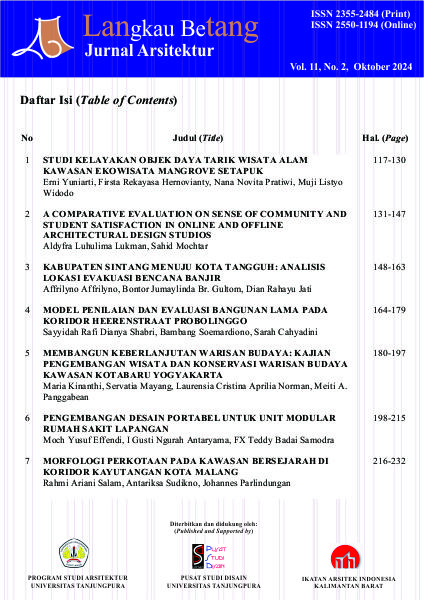
MORFOLOGI PERKOTAAN PADA KAWASAN BERSEJARAH DI KORIDOR KAYUTANGAN KOTA MALANG
DOI:
https://doi.org/10.26418/lantang.v11i2.77996Keywords:
Morfologi Perkotaan, Kawasan Bersejarah, Koridor KayutanganAbstract
Kawasan bersejarah dalam suatu kota sering dianggap sebagai pusat kehidupan sosial, ekonomi, dan politik. Namun, transformasi fisik terjadi seiring kemajuan kota, mengubah karakter kawasan tersebut. Koridor Kayutangan, sebelumnya dikenal dengan bangunan bersejarah kolonial Belanda, kini menjadi fokus pembangunan perkotaan yang kadang mengesampingkan nilai sejarahnya. Tujuan penelitian untuk mengetahui perubahan Koridor Kayutangan seiring perkembangan zaman dengan mengeksplorasi struktur fisik Koridor Kayutangan, Kota Malang. Pada penelitian ini menggunakan pendekatan morfologi perkotaan dengan menggunakan teknik analisis tipo-morfologi dan komparatif yang terfokus pada pola street, landuse dan building pada masa sebelum kemerdekaan dan setelah kemerdekaan. Hasil penelitian menunjukkan pola jalan dan fungsi Koridor tetap konsisten, meskipun beberapa perubahan terlihat dalam nama jalan, arus lalu lintas, moda transportasi dan parkir liar. Untuk penggunaan lahan Koridor ini masih menjadi pusat perdagangan dan jasa dengan beberapa penyesuaian pada fungsi bangunannya. Sedangkan bangunan di Koridor Kayutangan mengadaptasi bangunan bergaya modern, meskipun beberapa bangunan bergaya kolonial masih bertahan
References
Azis, B., Santosa, H., & Ernawati, J. (2019). Penilaian Persepsi Masyarakat Terhadap Bangunan Besejarah Di Koridor Kayutangan, Malang, Indonesia. Local Wisdom : Jurnal Ilmiah Kajian Kearifan Lokal, 11(1), 1–15. https://doi.org/10.26905/lw.v11i1.2514
Bianca, S. (2015). 3 Morphology as the Study of City Form and Layering. In Reconnecting the City: The Historic Urban Landscape Approach and the Future of Urban Heritage, First Edition. Edited by Francesco Bandarin and Ron van Oers (pp. 85–111).
Choirunnisak, & Afiyanto, H. (2020). Gemeente Malang : Keruangan, Segregasi, dan Potensi Wilayah 1914-1940. Historia Madania, 6(1905), 147–167.
Erine, K. N., Rimasari, S., & Sapto, A. (2022). Eksistensi bangunan gaya kolonial Belanda di kawasan Kayutangan , Kota Malang pada tahun 1900-. Journal of Indonesia History and Education, 2(Oktober), 588–602.
Fauziah, N., Antariksa, A., & Ernawati, J. (2012). Kualitas Visual Fasade Bangunan Modern Pasca Kolonial di Jalan Kayutangan Malang. Review of Urbanism and Architectural Studies, 10(2), 11–18. https://doi.org/10.21776/ub.ruas.2012.010.02.2
Handinoto. (1996). Perkembangan Kota Malang pada Jaman Kolonial (1914-1940). Dimensi, 22(September), 1–29.
Ibrahim, H. G. A. (2016). Regeneration of Sustainability in Contemporary Architecture: Approach Based on Native Function and Activities to Strengthen Identity. Procedia - Social and Behavioral Sciences, 216(October 2015), 800–809. https://doi.org/10.1016/j.sbspro.2015.12.077
Iranfar, M. (2018). The Presence of Modernist Architecture in Government’s educational Buildings at Lefkosa. Journal of Contemporary Urban Affairs, 2(1), 22–32. https://doi.org/10.25034/ijcua.2018.3653
Junianingrum, D., Wijaya, I. N. S., & Deni Agus Setyono. (2021). Kualitas Visual Elemen Citra Kawasan Kayutangan di Kota Malang. Planning for Urban …, 10(0341), 169–180. https://purejournal.ub.ac.id/index.php/pure/article/view/93%0Ahttps://purejournal.ub.ac.id/index.php/pure/article/viewFile/93/63
Karimi, H., Ghadirifaraz, B., Shetab Boushehri, S. N., Hosseininasab, S. M., & Rafiei, N. (2022). Reducing traffic congestion and increasing sustainability in special urban areas through one-way traffic reconfiguration. Transportation, 49(1), 37–60. https://doi.org/10.1007/s11116-020-10162-4
Kropf, K. (2009). Aspects of urban form. Urban Morphology, 13(2), 105–120. https://doi.org/10.51347/jum.v13i2.3949
Kropf, K. (2017). The Handbook Of Urban Morphology. In The Handbook Of Urban Morphology. https://doi.org/10.1002/9781118747711
Mandaka, M., Ikaputra, I., & Widyastuti, D. T. (2022). Tipologi dan Morfologi Kota Bersejarah Lasem. Jurnal Arsitektur Pendapa, 5(1), 58–75. https://doi.org/10.37631/pendapa.v5i1.594
Mulyadi, L., Fathony, B., & Prikasari, E. (2019). Monograf-Potensi Kampung Heritage Kayutangan Sebagai Destinasi Wisata di Kota Malang.
Deazha, 53(9), xii+207.
Mulyadi, L., Witjaksono, A., & Fathony, B. (2020). Karakter Kawasan Dan Arsitektur Kota Malang Jawa Timur. CV. Dream Litera Buana Anggota IKAPI No. 158/JTI/2015.
Oliveira, V. (2016). The Elements of Urban Form. Urban Book Series, 7–30. https://doi.org/10.1007/978-3-319-32083-0_2
Piutanti, R. (2019). Typology of fasade building in kayu tangan street corridor, Malang City. Local Wisdom : Jurnal Ilmiah Kajian Kearifan Lokal, 11(2), 107–120. https://doi.org/10.26905/lw.v11i2.2858
Pratiwi, M. A., Ernawati, J., & Yusran, Y. A. (2023). Sense of Place Dimensions of Historic Streets as Urban Heritage Tourism Sites: Streets in Kayutangan, Malang, Indonesia. ISVS E-Journal, 10(7), 300–317.
Ridjal, A. M., Antariksa, A., Suryasari, N., & Santoso, J. T. (2016). Building Form berdasarkan Sejarah Kawasan Bangunan pada Jalan Basuki Rahmat Malang. Review of Urbanism and Architectural Studies, 14(2), 34–46. https://doi.org/10.21776/ub.ruas.2016.014.02.4
Rizaldi, T. L. N., Hariyani, S., & Wardhani, D. K. (2010). Pelestarian lingkungan dan bangunan kn o be r s e j a r a h k a w a s a n k a y u t a n g a n k o t a m a l a n g. Arsitektur E-Journal, 3(0341).
Ronal Ridhoi, Erianti, H., & S.R, T. A. (2020). Kawasan Kayutangan Malang Dalam Lintasan Sejarah. In Suparyanto dan Rosad (2015 (Vol. 5, Issue 3).
Rustad, R. (2009). What is Contemporary Architecture? Changes in Architectural Competitions and Architectural Discourse. Nordic Journal of Architectural Research, 21, 142–150.
Siregar, J. P. (2018). The Meaning Change of Urban Heritage: A Socio-Semiotic Investigation of Historic Areas in Yogyakarta, Indonesia. 265.
Stojanovski, T., & Axelsson, Ö. (2019). Typo-Morphology and Environmental Perception of Urban Space. Urban Morphological Theory Udc, July, 822–834.
Tallo, A., Pratiwi, Y., & Astutik, I. (2014). Identifikasi Pola Morfologi Kota (Studi Kasus : Kecamatan Klojen, Kota Malang). Jurnal Perencanaan Wilayah Dan Kota, 25(3), 213–227. https://doi.org/10.5614/jpwk.2015.25.3.3
Wicaksono, G. W. T. (2017). Malang Stoomtram Maatschappij pada Masa Kolonial di Malang Tahun 1901-1930. Avatara: E-Journal Pendidikan Sejarah, 5(3), 639–649.
Wulandari, L. D. (2004). Kajian Historis Perkembangan Kota Malang Dalam Menggali Makna Pembentukan Alun-alun Kota Malang. Jurnal Teknik, XI No.1, 7823–7830.
Downloads
Additional Files
Published
Issue
Section
License
Copyright (c) 2024 LANGKAU BETANG: JURNAL ARSITEKTUR

This work is licensed under a Creative Commons Attribution-NonCommercial 4.0 International License.
Copyright Holder: Langkau Betang: Jurnal Arsitektur, By submitting the manuscript, Authors willing to delivered the copyright to the publisher. Authors are free to use their published manuscript as a reference in their later works

This work is licensed under a Creative Commons Attribution 4.0 International License.
You are free to:
- Share "” copy and redistribute the material in any medium or format
- Adapt "” remix, transform, and build upon the material
- for any purpose, even commercially.
- Attribution "” You must give appropriate credit, provide a link to the license, and indicate if changes were made. You may do so in any reasonable manner, but not in any way that suggests the licensor endorses you or your use.
- No additional restrictions "” You may not apply legal terms or technological measures that legally restrict others from doing anything the license permits.
- You do not have to comply with the license for elements of the material in the public domain or where your use is permitted by an applicable exception or limitation.
- No warranties are given. The license may not give you all of the permissions necessary for your intended use. For example, other rights such as publicity, privacy, or moral rights may limit how you use the material.
