
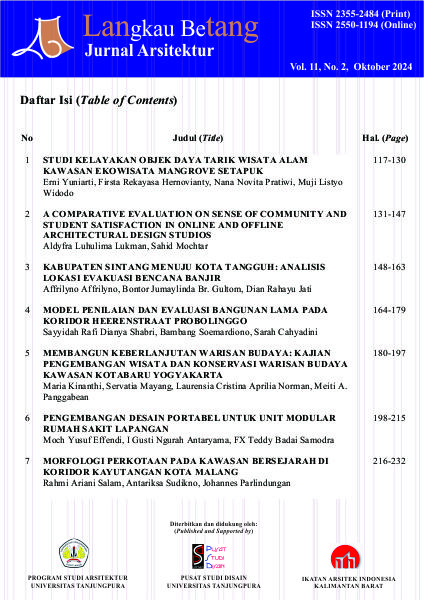
PENGEMBANGAN DESAIN PORTABEL UNTUK UNIT MODULAR RUMAH SAKIT LAPANGAN
DOI:
https://doi.org/10.26418/lantang.v11i2.83476Keywords:
Arsitektur Portabel, Beradaptasi, Darurat Bencana, Perakitan, Rumah Sakit LapanganAbstract
Rencana Kontijensi BPBD DIY tahun 2021 menghasilkan gempa bumi sesar opak berkategori aktif yang berdampak pada sektor pelayanan medis. Rumah sakit wilayah tersebut tidak semua siap menghadapi bencana karena tidak ada persiapan matang dan siklus bencana membuat pemasalahan semakin kompleks. Rumah sakit lapangan di Indonesia saat ini masih banyak permasalahan dalam cara perakitan yang memerlukan waktu lama dan tidak memiliki kelebihan tertentu menghadapi kondisi akibat bencana. Arsitektur portabel merupakan salah satu cara untuk menemukan solusi permasalahan desain ini, namun beberapa sistem dan teknologinya memiliki keterbatasan. Tujuan penelitian adalah merancang rumah sakit lapangan yang memiliki kemampuan efisiensi pengemasan serta dapat beradaptasi di lingkungan secara efektif. Metode kualitatif digunakan untuk mengumpulkan data survei konteks lokasi lahan berdasarkan aspek khusus pendirian rumah sakit lapangan dan rencana Kontijensi BPBD DIY tahun 2021, proses desain menggunakan force-based framework. Menunjukkan bahwa tingkat modularitas desain dalam mengemas bentuk cukup efisien dengan terintegrasinya peralatan medis, perakitan hanya membutuhkan waktu 19 menit dengan 4 orang dan memiliki kemampuan beradaptasi terhadap kontur lahan setempat. Hasil ini bermanfaat sebagai perkembangan kajian prinsip desain rumah sakit lapangan
References
Abidin, H. (2009). Deformasi Koseismik dan Pascaseismik Gempa Yogyakarta 2006 dari Hasil Survei GPS. Indonesian Journal on Geoscience, 4(4), 275–284. https://doi.org/10.17014/ijog.vol4no4.20095
Akhtar, M. H., & Ramkumar, J. (2023). Origami inspired deployable structures: Future mobile healthcare for low resource settings. 6th International Conference of Contemporary Affairs in Architecture and Urbanism – Full paper proceedings of ICCAUA2023, 14-16 June 2023, 209–219. https://doi.org/10.38027/iccaua2023en0337
Andjelkovic, V. (2016). Transformation principles in the architectural design of a contemporary house. archiDOCT, 4(1), 86–107. http://www.enhsa.net/archidoct/Issues/vol4_iss1/ArchiDoct_vol4_iss1 06 Transformation Principles in the Architectural Design of a Contemporary House Andjelkovic.pdf
Astley, P., Capolongo, S., Gola, M., & Tartaglia, A. (2015). Operative and design adaptability in healthcare facilities. Techne : Journal of Technology for Architecture and Environment, 9, 162–170. https://doi.org/10.13128/Techne-16118
Bakowski, J. (2016). A mobile hospital – its advantages and functional limitations. International Journal of Safety and Security Engineering, 6(4), 746–754. https://doi.org/10.2495/SAFE-V6-N4-746-754
Boafo, F. E., Kim, J. H., & Kim, J. T. (2016). Performance of modular prefabricated architecture: Case study-based review and future pathways. Sustainability (Switzerland), 8(6), 1–16. https://doi.org/10.3390/su8060558
Chaplin, A. (2014). ARCHITECTURE OF DIAGRAMS: A Taxonomy of Architectural Diagrams. ISSUU. https://books.google.co.id/books?id=Yu9VygEACAAJ
Clement, F. D., Qidong, L., Xingwen, Z., & Xiaojuan, L. (2022). Studies on Modular Emergency Buildings and Conservation. American …, January 2022, 57–64. https://doi.org/10.12691/ajcea-10-1-7
Departemen Kesehatan RI. (2007). Pedoman teknis penanggulangan krisis akibat bencana. Departemen Kesehatan Republik Indonesia.
Gänshirt, C. (2007). Tools for Ideas: Introduction to Architectural Design. DE GRUYTER. https://doi.org/10.1515/9783034609241
Haris, A., & Irjan, I. (2013). Analisis Percepatan Getaran Tanah Maksimum Wilayah Yogyakarta Dengan Metode Atenuasi Patwardhan. Jurnal Neutrino, 66–72. https://doi.org/10.18860/neu.v0i0.2433
Harrouk, C. (2020). Alternative Healthcare Facilities: Architects Mobilize their Creativity in Fight against COVID-19. ArchDaily. https://www.archdaily.com/937840/alternative-healthcare-facilities-architects-mobilize-their-creativity-in-fight-against-covid-19
Ibrahim. (2022). Mitigasi Potensi Gempa Yogyakarta, BMKG Sisir Sesar Opak. BADAN METEOROLOGI, KLIMATOLOGI, DAN GEOFISIKA. https://www.bmkg.go.id/berita/?p=mitigasi-potensi-gempa-yogyakarta-bmkg-sisir-sesar-opak&lang=ID
Iqbal, M., Budiyanto, H., & Bonifacius, N. (2021). RUMAH SAKIT DARURAT BENCANA DENGAN STRUKTUR PNEUMATIK TIUP. Mintakat: Jurnal Arsitektur, 22(2), 65–75. https://doi.org/10.26905/jam.v22i2.5372
Ismael, Z. K., & Khalil, K. F. (2022). Space Performance Assessment of a Relocatable Health Facility: Mosul Hospital as a Case Study. Buildings, 12(10), 1539. https://doi.org/10.3390/buildings12101539
Jormakka, K. (2014). Basics Design Methods. Birkhauser Basel, Switzerland.
Kementrian Kesehatan. (2008). Pedoman Pengelolaan Rumah Sakit Lapangan Untuk Bencana.
Kizilova, S. A. (2022). Mobile Reserve Architecture: Designing the Post-Pandemic Solutions. IOP Conference Series: Earth and Environmental Science, 988(5), 052029. https://doi.org/10.1088/1755-1315/988/5/052029
Kronenburg, R. (2013). Architecture in Motion “The history and development of portable building†(1st Editio). Routledge. https://doi.org/10.4324/9780203408964
Kyrö, R., Jylhä, T., & Peltokorpi, A. (2019). Embodying circularity through usable relocatable modular buildings. Facilities, 37(1/2), 75–90. https://doi.org/10.1108/F-12-2017-0129
Maden, F. (2019). the Architecture of Movement: Transformable Structures and Spaces. In Livenarch VI Livable Environments and Architecture International Congress, Replacing Architecture.
Mauricio Soto-Rubio. (2020). The Geometry of Felix Escrig. Simplified Modelling Techniques for Modular Deployable Structures of Expandable Frames. Journal of Civil Engineering and Architecture, 14(3), 121–132. https://doi.org/10.17265/1934-7359/2020.03.001
Mele, T. Van, De Temmerman, N., De Laet, L., & Mollaert, M. (2010). Scissor-hinged retractable membrane structures. International Journal of Structural Engineering, 1(3–4), 374–396. https://doi.org/10.1504/IJSTRUCTE.2010.033489
Mudayana, A. A. (2017). Kesiapan Rumah sakit Diwilayah Yogyakarta Dalam Menghadapi Bencana. https://eprints.uad.ac.id/3517/
Parker, H. (2017). Modular for Architects. https://api.semanticscholar.org/CorpusID:203987833
Phocas, M. C., Matheou, M., & Haase, W. (2022). Transformable building structures in architectural engineering education. Architecture, Structures and Construction, 2(1), 183–198. https://doi.org/10.1007/s44150-022-00022-3
Plowright, P. D. (2014). Revealing Architectural Design. In Revealing Architectural Design: Methods, Frameworks and Tools. Routledge. https://doi.org/10.4324/9781315852454
Pressman, A. (2019). Design thinking : a guide to creative problem solving for everyone. In Ebook (Vol. 86, Nomor 6). New York : Routledge.
Suh, S. (2018). A study on the site selection process of field emergency medical facilities based on text mining. Journal of the Korea Institute of Healthcare Architecture, 27–36. https://doi.org/10.15682/jkiha.2018.24.2.27
Tekin, E., Bayramoglu, A., Uzkeser, M., & Cakir, Z. (2017). Afet durumunda hastanelerin tahliyesi, sahra hastanesinin kurulumu ve haberleşme. Eurasian Journal of Medicine, 49(2), 137–141. https://doi.org/10.5152/eurasianjmed.2017.16102
Wiarto, G. (2017). Tanggap Darurat Bencana Alam. Yogyakarta: Gosyen Publishing.
Yang, M., Suh, S., & Lee, Y. (2018). A Study on the Historical Background and Deployment Characteristics of Mobile Hospital for Disaster-Focused on Military Mobile Hospitals. Journal of The Korea Institute of …, 24(3), 39–47. https://doi.org/10.15682/jkiha.2018.24.3.39
Downloads
Additional Files
Published
Issue
Section
License
Copyright (c) 2024 LANGKAU BETANG: JURNAL ARSITEKTUR

This work is licensed under a Creative Commons Attribution-NonCommercial 4.0 International License.
Copyright Holder: Langkau Betang: Jurnal Arsitektur, By submitting the manuscript, Authors willing to delivered the copyright to the publisher. Authors are free to use their published manuscript as a reference in their later works

This work is licensed under a Creative Commons Attribution 4.0 International License.
You are free to:
- Share "” copy and redistribute the material in any medium or format
- Adapt "” remix, transform, and build upon the material
- for any purpose, even commercially.
- Attribution "” You must give appropriate credit, provide a link to the license, and indicate if changes were made. You may do so in any reasonable manner, but not in any way that suggests the licensor endorses you or your use.
- No additional restrictions "” You may not apply legal terms or technological measures that legally restrict others from doing anything the license permits.
- You do not have to comply with the license for elements of the material in the public domain or where your use is permitted by an applicable exception or limitation.
- No warranties are given. The license may not give you all of the permissions necessary for your intended use. For example, other rights such as publicity, privacy, or moral rights may limit how you use the material.
